In aerospace plastics manufacturing, precision is not optional. Plastic components used in aircraft interiors, panels, ducts, and specialized assemblies must meet demanding requirements for consistency, weight, strength, and durability. That level of process control depends on more than molds and raw materials. It also depends on a compressed air system that delivers stable performance day after day. When air compressors are reliable, manufacturers are better positioned to protect part quality, reduce downtime, control maintenance costs, and improve long-term return on investment.
Reliable air compressors are important because they provide the consistent compressed air needed to support precision molding, stable cycle performance, lower defect rates, and dependable plant uptime. In practical terms, compressor reliability helps aerospace plastics manufacturers avoid costly interruptions, reduce scrap and rework, simplify maintenance planning, and get more long-term value from their equipment investments.
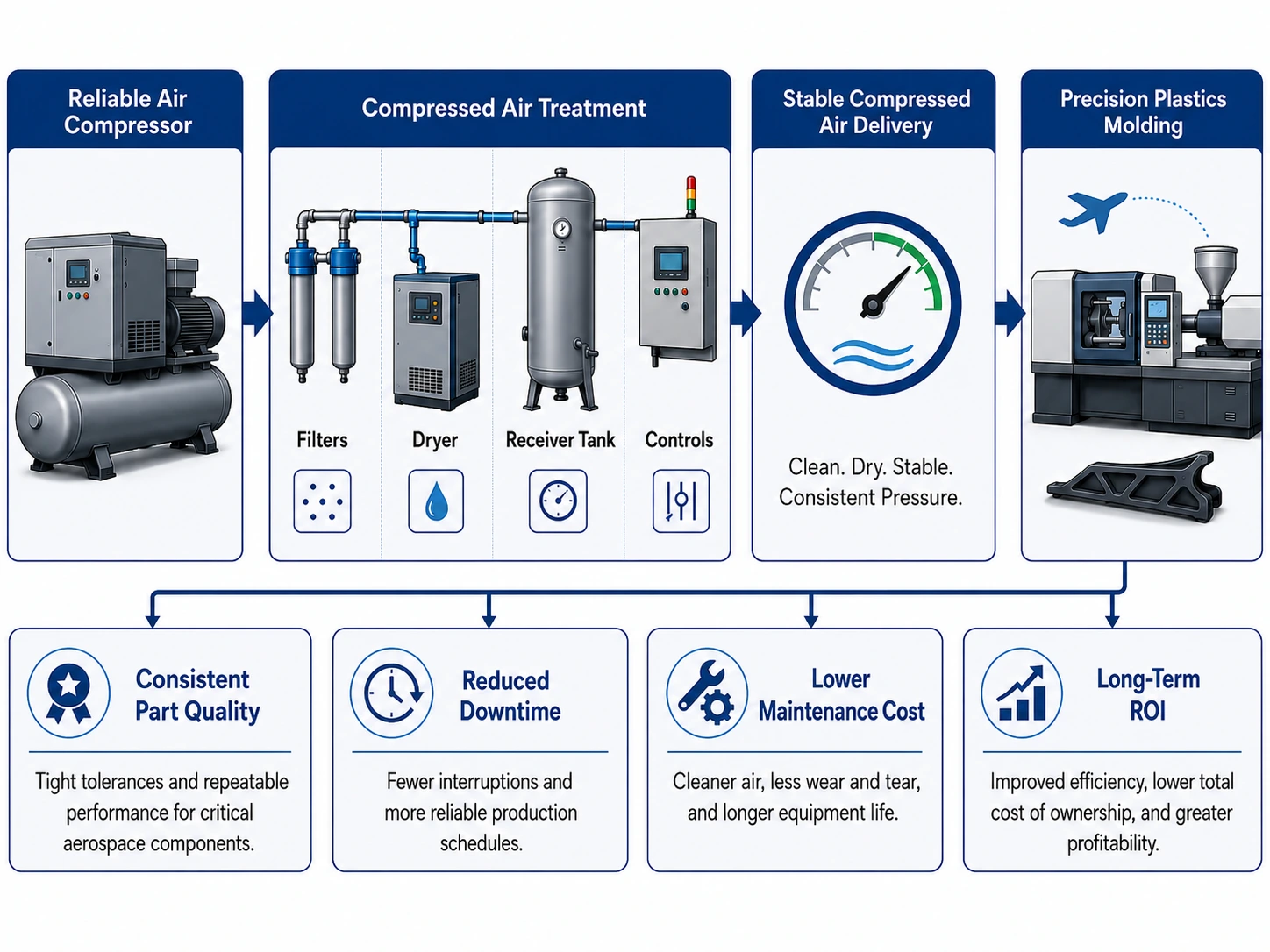
Aerospace plastics manufacturing depends on repeatable production conditions. Small variations in air pressure, air quality, or system stability can affect molding performance and introduce process inconsistency. In a production environment where precision matters, unreliable compressed air is more than a maintenance inconvenience. It can become a direct threat to throughput, quality, and schedule confidence.
That is why compressed air should be treated as a production-critical utility. When compressor systems perform consistently, operations teams can run with greater confidence, maintenance teams can plan instead of react, and production leaders can make better decisions around output, uptime, and total operating cost.
Plastics molding processes used in aerospace applications require stable operating conditions. If the compressed air supply fluctuates, the result can be inconsistent cycle performance, increased reject rates, and avoidable rework. Reliable compressors help support the steady air delivery needed to keep molding processes controlled and repeatable.
Consistent air supply can help manufacturers improve:
For manufacturers producing aerospace-grade components, that kind of consistency is central to both quality performance and cost control.
Unplanned downtime is one of the most expensive problems in any manufacturing environment, especially in applications tied to strict quality standards and delivery expectations. A compressor-related failure can stop production, delay shipments, increase labor inefficiency, and force teams into reactive troubleshooting. Even a brief interruption can trigger downstream consequences across multiple parts of the operation.
Reliable compressor systems help reduce that risk by supporting:
In demanding aerospace plastics environments, uptime protection is a major part of the value equation.
Preventive maintenance is essential to keeping compressed air systems operating at a high level, but the effectiveness of any maintenance program depends in part on the equipment itself. Compressors that are easier to inspect, service, and maintain help teams stay ahead of small problems before those issues escalate into failures.
A strong preventive maintenance approach often includes routine inspections, filter replacement, oil monitoring where applicable, and ongoing system checks. When compressors are built for dependable serviceability, maintenance teams can carry out those tasks more efficiently and with less disruption to the operation.
This matters because preventive maintenance is not just about preserving the machine. It is about preserving uptime, controlling repair costs, and keeping the manufacturing process stable over time.
Compressor selection should be evaluated on total long-term value, not simply on initial purchase price. In aerospace plastics manufacturing, reliable compressor systems can deliver strong ROI by reducing failures, lowering maintenance frequency, and extending useful equipment life. A system that stays dependable over the long term helps operations avoid the repeated costs associated with premature replacement, emergency repairs, and chronic inefficiency.
Longer life cycles can support ROI through:
When viewed through that lens, reliability is not just a technical feature. It is a financial advantage.
Reliability and efficiency often work together. Compressor systems that operate dependably and are well matched to the application are generally better positioned to use energy and resources more effectively than systems that struggle with instability or chronic service problems. In aerospace plastics manufacturing, that can translate into lower electricity consumption, fewer wasted production hours, and better control over operating costs.
For manufacturers focused on long-term performance, resource efficiency matters because it supports both profitability and broader sustainability goals. Reducing waste, controlling energy use, and improving system stability all contribute to a more resilient operation.
It is easy to think about compressor reliability as a maintenance issue alone, but in reality it reaches much further than that. Reliable compressed air supports quality assurance, production planning, labor efficiency, and cost control. It helps engineers maintain process consistency, gives maintenance teams a more manageable service environment, and helps operations leaders protect output.
That is why reliability should be considered a strategic advantage in aerospace plastics manufacturing. A dependable compressed air system supports more than equipment performance. It helps protect the overall economics of the process.
When evaluating compressor systems for aerospace plastics operations, manufacturers should look beyond nameplate performance. The right solution should align with production demands, quality requirements, service expectations, and long-term operating goals.
Key evaluation factors often include:
For facilities reviewing compressed air infrastructure for demanding industrial processes, Southeast Turbo Machinery Equipment provides compressor solutions designed to support dependable performance and long-term operational value. For operations with related fluid-handling needs, the company also supports industrial pump applications across a range of process environments.
In aerospace plastics manufacturing, compressor reliability has a direct effect on production quality, uptime, maintenance efficiency, and long-term ROI. Stable compressed air helps support precision molding, reduce defects, and keep operations moving without avoidable interruption. Over time, reliable systems also help extend equipment life, lower total operating costs, and improve resource efficiency.
If your facility is dealing with compressor-related downtime, rising maintenance demands, or inconsistent air system performance, it may be time to reevaluate whether your current setup is aligned with your production goals. To discuss your application and identify compressed air solutions built for reliability, efficiency, and long-term value, reach out through the contact page.
Compressor reliability is important because stable compressed air supports precision molding, reduces defects, protects uptime, and helps manufacturers maintain more consistent production performance.
Reliable compressors improve ROI by reducing unplanned downtime, lowering maintenance costs, extending equipment life, and helping manufacturers avoid scrap, rework, and emergency repairs.
Preventive maintenance helps preserve compressor performance by identifying issues early, supporting stable operation, reducing failure risk, and keeping the compressed air system aligned with production demands.
Yes. Compressor reliability can affect product quality because unstable air pressure or inconsistent air supply can disrupt molding conditions and contribute to defects, scrap, or process inconsistency.
Manufacturers should look for consistent air delivery, reliability, serviceability, efficiency, long-term durability, and a strong fit with their production requirements and uptime goals.

