In aerospace plastics manufacturing, performance depends on more than material science and tooling. It also depends on the compressed air systems that support molding, extrusion, finishing, and plant-wide reliability. Advanced plastics used in aerospace applications must meet exacting standards for durability, weight, and dimensional consistency, which means production conditions have to remain controlled from one cycle to the next. Well-maintained air compressors help make that possible by supporting cleaner air delivery, stronger uptime, safer operation, and better long-term efficiency.
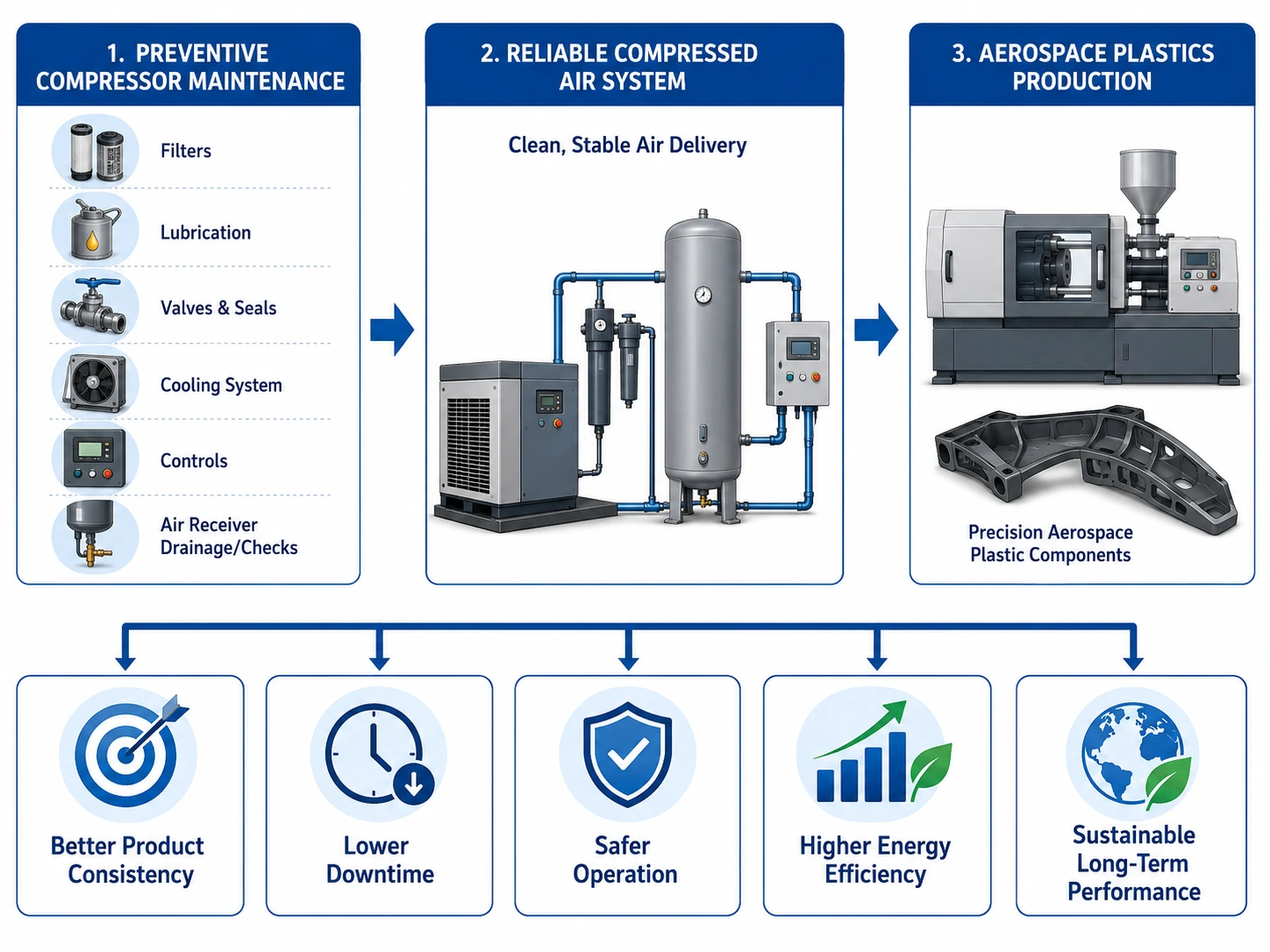
Air compressors support aerospace plastics production by providing the stable compressed air needed for shaping, curing, finishing, and process control. In practical terms, reliable compressor performance helps manufacturers maintain product consistency, reduce downtime, improve safety, and operate with better energy efficiency across demanding production environments.
Aerospace plastics operations depend on consistent process conditions. Whether the application involves molding advanced polymer components, supporting extrusion lines, or assisting finishing processes, compressed air helps maintain the stability required for repeatable results. When air supply becomes inconsistent, manufacturers may face product defects, wasted material, interrupted production, and increased maintenance pressure.
That is why compressor performance should be treated as a core production issue rather than a background utility concern. For facilities evaluating compressed air infrastructure for demanding industrial environments, Southeast Turbo Machinery Equipment offers industrial compressor systems designed to support reliable operation and long-term process value.
The reference content makes a clear point: sustainable strength starts with disciplined compressor maintenance. In aerospace plastics manufacturing, even small system issues can affect much more than equipment condition. A clogged filter, a failing seal, or a cooling problem can contribute to unstable pressure, higher energy use, reduced product consistency, or safety concerns that ripple through the process.
Preventive maintenance helps reduce those risks by keeping the compressor system aligned with production demands. It also helps manufacturers protect both short-term uptime and long-term operating value.
Reliable compressor performance depends on several key components working together. If any of them begin to fail or fall out of spec, the effect can show up quickly in air delivery, operating efficiency, or system safety.
Filters help keep dust, oil, and contaminants out of the air stream. When filters become clogged, airflow suffers, efficiency drops, and overheating risk increases. Regular inspection and replacement help preserve air quality and system stability.
Proper lubrication helps reduce friction and wear in moving components. Low oil levels, poor oil condition, or incorrect lubricant selection can accelerate damage and increase failure risk. Monitoring lubrication closely is essential to reliable compressor operation.
Valves and seals help maintain pressure integrity. If they begin to leak, air loss and instability can affect both efficiency and process consistency. Regular leak checks and timely seal replacement support stronger system performance.
Compressed air systems generate heat, and inadequate cooling can shorten equipment life and increase the risk of shutdowns. Cooling surfaces, airflow paths, and coolant circulation should all be part of routine maintenance attention.
Wear in these components can lead to vibration, misalignment, and inefficient power transfer. Inspecting tension, alignment, and condition helps reduce avoidable mechanical failures.
Sensors, wiring, and controls regulate compressor operation and safety. If these systems are unreliable, the result may be nuisance shutdowns, unsafe conditions, or inconsistent performance. Testing connections and control response should be part of ongoing preventive care.
The air receiver tank supports compressed air storage and delivery, but moisture accumulation can create corrosion and long-term safety risk. Regular draining and inspection are essential to maintaining safe, dependable operation.
Operators and maintenance teams should be trained to catch early signs of compressor trouble before those issues become major failures. The earlier a problem is identified, the easier and less expensive it usually is to correct.
Common warning signs include:
These symptoms often point to deeper mechanical, cooling, lubrication, or air treatment issues. Addressing them quickly helps prevent larger production and safety problems.
The strongest compressor performance does not come from occasional service alone. It comes from building a preventive care culture around the equipment. That means aligning inspections with production cycles, documenting maintenance activity, training teams to recognize warning signs, and involving experienced service support when specialized attention is needed.
A preventive care culture can help manufacturers improve:
That proactive mindset is one of the most effective ways to protect both productivity and long-term equipment value.
Well-maintained compressor systems do more than reduce repair risk. They also support more sustainable operation. Compressors that run efficiently use less energy, generate less waste from avoidable failures, and help facilities reduce the emissions associated with unnecessary power consumption. In aerospace plastics manufacturing, that matters because sustainability goals must be achieved without sacrificing process precision.
Reliable maintenance practices support that balance by helping manufacturers lower energy waste, extend equipment life, and reduce the operational disruptions that often create excess material and labor waste.
For aerospace plastics operations, maintaining sustainable strength means looking beyond basic compressor output. Manufacturers should evaluate how well the system supports safe, efficient, and repeatable performance over time.
Key considerations often include:
For manufacturers with broader rotating equipment needs across the facility, Southeast Turbo Machinery Equipment also provides industrial pump solutions for demanding process applications.
For aerospace plastics manufacturers, sustainable strength starts with reliable compressor performance and disciplined maintenance. Well-maintained air compressors help support safer operations, more consistent product quality, lower energy waste, and fewer unexpected shutdowns. Over time, that proactive approach strengthens both productivity and environmental performance without compromising the precision aerospace manufacturing requires.
If your operation is seeing pressure fluctuations, excess heat, recurring leaks, or rising maintenance demands, now is the right time to evaluate whether your compressed air system is fully supporting your long-term goals. To discuss your application and identify compressor solutions built for safe, sustainable, and dependable performance, connect with Southeast Turbo Machinery Equipment through the contact page.
Air compressors are important because they supply the stable compressed air needed for molding, extrusion, curing, finishing, and process control in aerospace plastics production.
Compressor maintenance is important because small issues can quickly affect air quality, pressure stability, equipment safety, product consistency, and overall production efficiency.
Manufacturers should regularly inspect filters, lubrication systems, valves, seals, cooling components, belts, couplings, electrical controls, and air receiver tanks.
Warning signs include unusual noise, vibration, pressure fluctuations, excessive heat, oil carryover, visible leaks, and moisture buildup in tanks or air lines.
Well-maintained compressors support sustainability by reducing wasted energy, lowering emissions tied to inefficient operation, extending equipment life, and helping facilities avoid unnecessary downtime and material waste.

