Compressed air supports critical equipment throughout pulp and paper manufacturing. Pneumatic actuators, control valves, instrumentation, automation, air knives, material handling systems, maintenance tools, and other production assets depend on air being available at the right pressure when it is needed.
That makes compressed air a plant-wide operating system rather than simply a utility in the compressor room. When supply matches demand and pressure remains stable, equipment can perform consistently. When leaks, pressure losses, poor controls, incorrect sizing, or equipment deterioration develop, energy use and maintenance demands can increase even while production appears to continue normally.
For pulp and paper mills in Georgia, Florida, and across the Southeast, improving compressed air performance means looking beyond compressor horsepower. The stronger approach is to understand how air is generated, stored, treated, distributed, controlled, and ultimately used across the mill.
Pulp and paper mills can improve compressed air performance by matching compressor capacity to actual airflow demand, maintaining only the pressure production requires, reducing leaks and pressure losses, providing adequate storage and air treatment, improving controls, and monitoring operating conditions over time. The goal is stable, usable compressed air with less wasted energy and fewer unplanned interruptions.
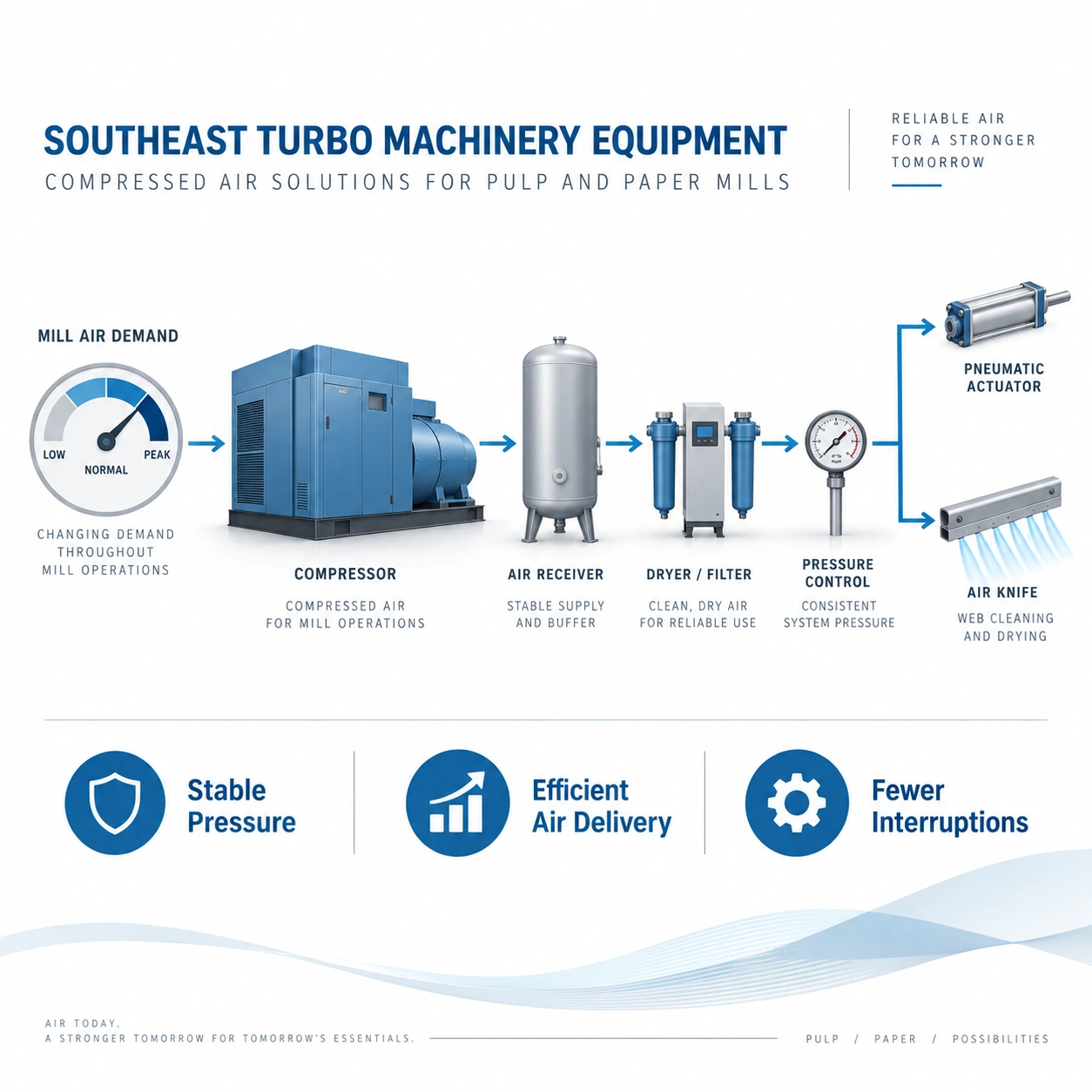
Compressed air serves many functions across a pulp and paper facility, which is why disturbances in one utility system can affect equipment in multiple production areas.
Typical compressed air applications may include:
These applications do not necessarily have identical pressure, flow, or air-quality requirements. Instrument air may have different treatment expectations than general plant air, while an air knife may create a very different demand profile from a pneumatic actuator.
That is why reliable compressed air begins with understanding how individual uses contribute to the mill's total demand.
A common mistake in compressed air planning is assuming that more compressor capacity automatically produces a more reliable system. Oversizing and undersizing can both create problems.
An oversized compressor may spend too much time operating inefficiently at partial load or cycling when demand is low. An undersized compressor may run continuously and still fail to maintain adequate pressure when production reaches peak demand.
A practical sizing review should consider:
Facilities evaluating new equipment can review STME's industrial compressors and compressed air systems as part of an application-based equipment review.
The correct capacity is the capacity that supports actual operating demand with an appropriate margin for realistic peaks and future needs—not simply the largest machine available.
When operators experience pressure problems, adding compressor horsepower can seem like the obvious solution. However, pressure at the point of use depends on more than compressor output.
Pressure can be lost through:
If these conditions are not corrected, additional compressor capacity may simply provide more air to an inefficient distribution system.
Mill teams should therefore determine where pressure is being lost before concluding that the compressor itself is undersized.
Compressed air requires significant electrical input to produce. Because industrial compressors can accumulate substantial runtime, small inefficiencies that persist every shift can turn into meaningful operating expense.
Some of the most common sources of waste include:
A system may still appear to work while these losses remain hidden. Production equipment receives air, but the compressors may be operating longer, cycling more frequently, or generating higher pressure than necessary to overcome system inefficiencies.
The better efficiency question is therefore not simply, "How efficient is the compressor?" It is, "How efficiently does the complete system deliver usable air to production?"
Increasing discharge pressure can temporarily compensate for pressure drop elsewhere in the system, but it can also increase compressor workload and make air leaks more costly.
The stronger approach is to identify what pressure production equipment actually requires and then determine whether the distribution system can deliver that pressure without unnecessary loss.
This may involve reviewing:
Comparing pressure at different locations helps plant teams see whether capacity is genuinely insufficient or whether restriction elsewhere in the system is creating the problem.
Pulp and paper mills rarely consume compressed air at exactly the same rate throughout every shift. Equipment cycles, production schedules change, and maintenance activity can temporarily increase demand.
Variable-speed compressors can be useful in systems where demand changes substantially because compressor output can follow the load more closely.
However, variable-speed operation should not be treated as the default answer to every efficiency problem.
A facility with relatively steady demand may be better served by fixed-speed equipment operating near an efficient load point. Other mills may benefit from a combination of fixed-speed base-load equipment and variable-speed trim capacity.
The appropriate configuration depends on actual load patterns, which is why measuring or understanding demand before selecting equipment is so important.
Short bursts of high air use do not always mean that permanent compressor capacity must be increased.
Properly applied receiver storage can help supply temporary demand while reducing the need for compressors to react to every short fluctuation. Controls can also coordinate multiple compressors so that capacity is brought online in a more organized way.
A compressed air strategy should therefore consider three related questions:
Answering those questions creates a stronger basis for deciding whether the system needs additional capacity, more storage, improved controls, or a different equipment configuration.
Dryers and filters help provide the air quality required by production equipment, controls, and instrumentation. However, air treatment also creates resistance in the system and should be selected and maintained appropriately.
A dirty filter or restrictive treatment component can create pressure drop that forces compressors to operate at higher discharge pressure to maintain the same pressure downstream.
Plant teams should consider both sides of the requirement:
Routine maintenance of filters, dryers, drains, and related components therefore contributes to both air quality and energy performance.
Compressed air monitoring gives maintenance teams greater visibility into changes that may otherwise develop gradually.
Useful indicators can include:
Trends often provide more useful information than a single measurement.
If compressor runtime increases while production remains relatively unchanged, the system may have developed new leaks or losses. Repeated pressure fluctuations may indicate storage limitations, temporary demand spikes, control problems, or insufficient usable capacity.
Rising operating temperature may point toward dirty coolers, ventilation limitations, cooling-system problems, or a developing equipment condition that requires investigation.
Monitoring does not eliminate routine maintenance. It helps maintenance personnel identify where changing performance deserves attention before it becomes an emergency.
A reactive maintenance strategy waits until compressor performance has deteriorated enough to interrupt operations. In a continuous production environment, that can create emergency labor, unplanned downtime, and pressure on the rest of the maintenance schedule.
Condition-based maintenance uses operating trends to identify developing concerns earlier.
Maintenance teams can use changes in temperature, runtime, pressure behavior, cycling, energy use, and service frequency to help determine whether equipment needs closer inspection.
This can make it easier to:
For additional context on evaluating compressor performance over time, STME's resource on air compressor reliability and long-term operating value discusses how maintenance, energy use, and equipment condition affect industrial compressor economics.
The purchase price of a compressor is visible immediately. Many of the larger costs associated with owning the equipment occur later.
A lifecycle evaluation can consider:
A lower-cost compressor can become the more expensive choice if energy consumption or maintenance demands are substantially higher over time. Likewise, higher-efficiency equipment may justify additional initial cost when lower operating expense and stronger reliability are considered across the equipment lifecycle.
The objective is to compare the cost of reliably delivering the required compressed air—not just the cost of buying the compressor.
Reducing compressed air waste can support mill sustainability objectives because unnecessary air production also represents unnecessary electrical consumption.
Practical improvement opportunities may include:
Reliability supports the same objective. Extending useful equipment life reduces premature replacement, while planned maintenance can prevent failures that consume parts, labor, and production time.
Efficiency without reliability does not create a strong production system. Reliability with unnecessarily high energy consumption also leaves value on the table. The strongest compressed air strategy addresses both.
There is no single formula that determines whether an aging industrial compressor should remain in service.
Repair may be appropriate when:
Replacement deserves closer evaluation when:
An upgrade may also be appropriate when the existing compressor remains serviceable but controls, storage, air treatment, or distribution changes can address the larger system problem.
Downtime exposure should be included in every decision. The cost of compressor failure can extend beyond the repair invoice to lost production, overtime, schedule disruption, and delayed customer commitments.
Recurring compressor problems do not always begin inside the compressor.
Piping, receivers, dryers, filters, valves, controls, pressure settings, air leaks, and changing production demand all influence the work the compressor must perform.
Before replacing equipment or increasing horsepower, plant teams should ask:
That system-level approach helps distinguish the root cause from the symptom. It also reduces the risk of installing new equipment into a system that continues to create the same pressure, efficiency, or reliability problems.
Pulp and paper mills in Georgia and Florida depend on compressed air for controls, automation, instrumentation, material handling, air knives, maintenance tools, and other production applications. Maintaining that utility efficiently requires more than installing enough compressor horsepower.
Proper sizing, pressure management, storage, air treatment, distribution, controls, leak management, monitoring, and maintenance all influence how reliably compressed air reaches production.
For mills experiencing unstable pressure, rising energy costs, excessive compressor cycling, recurring repairs, or changing production requirements, evaluating the complete system can reveal whether the most effective next step is maintenance, an operating adjustment, a system upgrade, or new compressor equipment.
To discuss your mill's compressed air requirements and operating conditions, contact Southeast Turbo Machinery Equipment.
Compressed air can support pneumatic controls, actuators, instrumentation, automation, air knives, material handling, packaging, maintenance tools, pneumatic conveying, and other air-dependent mill equipment.
Sizing should consider average and peak airflow demand, required operating pressure, production shifts, duty cycle, air-quality requirements, storage, distribution losses, demand spikes, and expected future production needs.
Common causes include air leaks, excessive pressure settings, improper compressor sizing, poor sequencing, insufficient storage, dirty filters, pressure drops, and inefficient loading and unloading.
A variable-speed compressor can be useful when compressed air demand changes significantly because output can adjust more closely to actual airflow requirements. Facilities with steady demand may be better suited to fixed-speed equipment or a combination of compressor types.
Pressure and capacity problems can be caused by leaks, piping restrictions, dirty filters, inadequate storage, air-treatment losses, poor controls, or changing production demand. Evaluating the complete system helps identify the actual cause before additional compressor capacity is added.

