Wine and beer production depends on much more than tanks, pumps, fermentation vessels, and packaging lines. Behind many critical operations is a compressed air system supplying pneumatic controls, actuators, packaging equipment, instrumentation, automation, tools, and other air-dependent processes.
Because compressed air serves multiple areas of production, compressor selection should be treated as a system decision rather than simply a horsepower purchase. The equipment must provide the airflow, pressure, and air quality required by the applications it serves while responding appropriately to changing production demand.
For wineries and breweries, the objective is straightforward: deliver usable compressed air where production needs it, at the required pressure and quality, without unnecessary energy use or operating problems.
Compressed air supports winery and brewery production by powering pneumatic valves, actuators, packaging equipment, automation, instrumentation, tools, and other air-operated systems. In some wineries, compressed air may also supply nitrogen-generation equipment. Reliable performance depends on matching compressor capacity, pressure, air treatment, storage, controls, and distribution to the facility's actual applications and demand patterns.
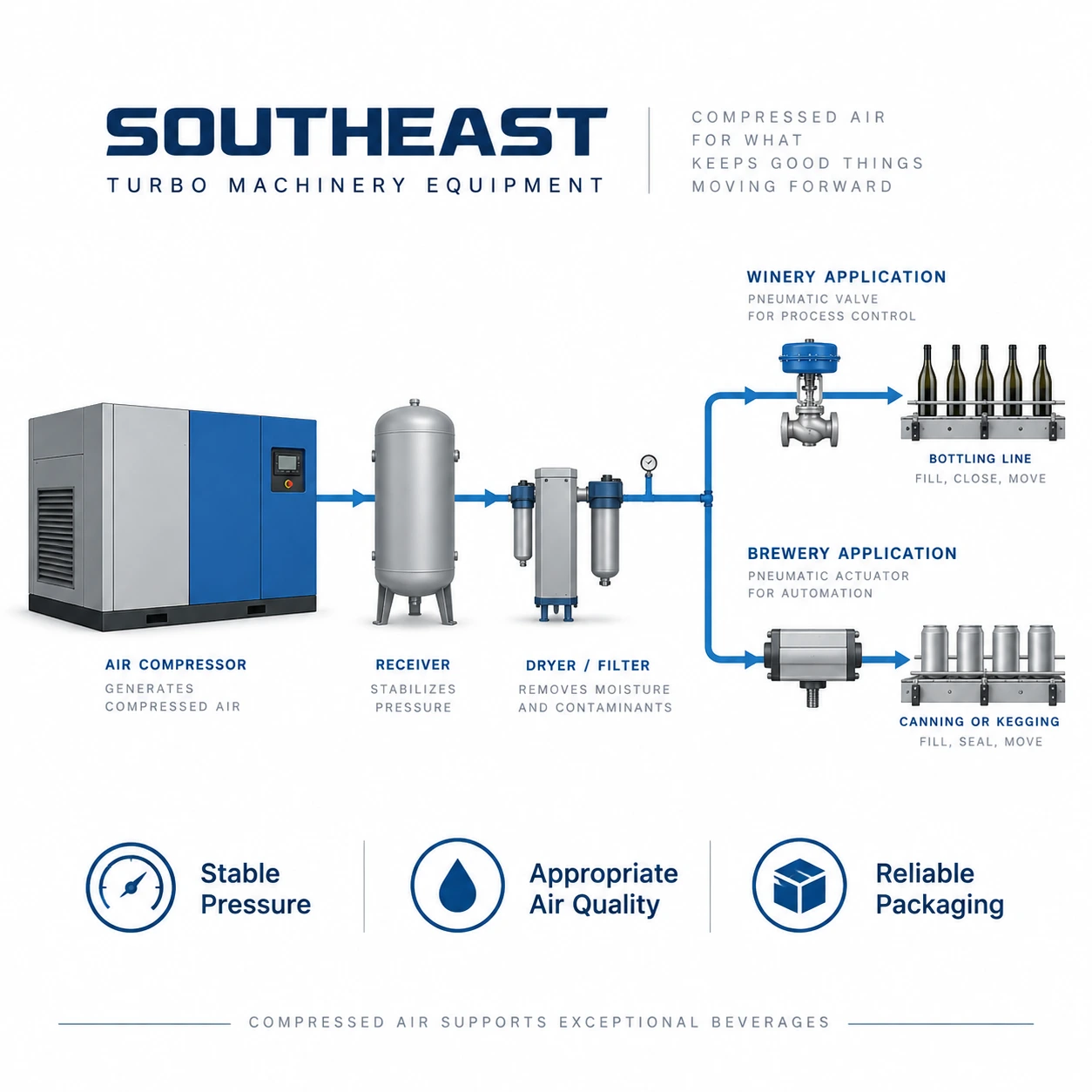
Wineries can use compressed air from early processing through final packaging. The exact applications depend on the facility's equipment and level of automation, but pneumatic power is often used where repeatable movement and control are required.
Potential winery applications include:
These applications can have different airflow and pressure requirements. A valve actuator may use air intermittently, while packaging equipment can create repeated or simultaneous demand during a production run.
That variation is why a winery should evaluate the complete demand profile instead of sizing a compressor around one machine or one peak event.
Facilities considering new or replacement equipment can review STME's industrial compressors and compressed air systems as part of an application-focused system evaluation.
Breweries use pneumatic equipment to automate processes that would otherwise require manual adjustment. Pneumatic valves and actuators can support flow control through brewing, fermentation, filtration, transfer, cleaning, and packaging systems.
Compressed air may support:
Reliable pressure is especially important where multiple devices operate at the same time. Packaging lines can bring several pneumatic functions online in quick succession, creating a different demand pattern from normal process operation.
If the air system cannot respond to those peaks, operators may see pressure fluctuations or inconsistent equipment behavior even when average compressor capacity appears adequate.
A winery or brewery may have relatively modest air demand during some production stages and significantly higher demand during packaging. Bottling, canning, kegging, labeling, capping, corking, conveying, and pneumatic handling can operate simultaneously.
That makes average airflow only part of the sizing calculation.
Facilities should also consider:
A system that performs well during cellar or brewhouse operations may still struggle when the packaging line comes online. Understanding those production patterns before selecting equipment helps prevent pressure problems later.
Not every compressed air use inside a winery or brewery requires identical air quality. Air operating a general maintenance tool has a different function from air serving instrumentation, packaging equipment, or an application located close to the product process.
Potential contaminants to manage may include:
That means compressor selection should be considered together with air treatment and distribution. Dryers, filters, drains, receivers, piping condition, and routine maintenance all influence what eventually reaches production equipment.
Oil-free compressor technology may be appropriate where reducing the risk of lubricant entering the compressed-air stream is important. However, selecting an oil-free compressor does not eliminate the need to evaluate drying, filtration, piping cleanliness, condensate control, and the complete air path.
The correct treatment strategy starts with identifying what air quality each end use actually requires.
Some wineries use compressed air as the feed source for on-site nitrogen-generation equipment. The generated nitrogen may then be used for applications such as tank blanketing where reducing oxygen exposure is desirable.
In this type of system, compressor performance affects the gas-generation process indirectly. The compressor must provide the airflow, pressure, and feed-air condition required by the nitrogen-generation equipment.
Important considerations can include:
The nitrogen generator should therefore be included when evaluating the winery's total compressed-air demand rather than treated as an isolated utility.
Compressor sizing should begin with how the facility actually operates. Replacing an existing compressor with the same horsepower does not necessarily mean the new system will match current production requirements.
A practical sizing review should consider:
An oversized compressor may operate inefficiently when demand is low. An undersized system may run continuously while struggling to maintain pressure during production peaks.
The goal is not maximum compressor capacity. It is enough usable capacity to support actual demand efficiently and predictably.
Winery and brewery air demand can change significantly depending on which production equipment is operating. That makes the facility's load profile important when choosing a compressor control strategy.
A variable-speed compressor can be useful when demand changes substantially because compressor output can follow airflow requirements more closely instead of operating at one fixed output condition.
A facility with stable, continuous demand may be better suited to fixed-speed equipment operating near an efficient loading condition.
Larger operations may benefit from more than one compressor, allowing equipment to be sequenced according to demand rather than forcing one machine to cover every operating condition.
No single arrangement is automatically best. The appropriate configuration depends on actual airflow patterns, operating hours, production peaks, required redundancy, and expected growth.
Packaging and automated equipment can create brief demand spikes that are very different from the facility's normal air consumption.
Properly applied receiver storage can help the system respond to those short-duration events without requiring the compressor to react immediately to every fluctuation.
Storage should be considered together with:
Adding permanent compressor horsepower to address a short peak may not always be the most effective solution. The underlying demand pattern should be understood first.
The pressure displayed at the compressor does not necessarily equal the pressure available at the bottling line, actuator, press, or packaging equipment.
Pressure can be lost through:
When production equipment experiences low pressure, simply raising compressor discharge pressure may mask these losses rather than solve them.
A stronger system evaluation compares pressure at different points between the compressor and the end-use equipment to identify where restriction or loss is occurring.
Air lost through leaks still has to be compressed. The compressor consumes electricity to produce that air even though it never reaches a productive application.
Leaks can develop in:
As total leakage grows, compressors may run longer or cycle differently to maintain plant pressure. That can make an otherwise adequate compressor appear too small for the facility.
Leak identification and repair should therefore be part of compressed-air system management, particularly when runtime or energy consumption increases without a corresponding increase in production.
Compressed-air problems often develop gradually. Monitoring provides maintenance teams with operating information that can help reveal those changes before they become major production issues.
Useful indicators can include:
For example, longer runtime with no major increase in production may indicate new leaks or declining system efficiency. Repeated pressure fluctuations may point toward storage limitations, controls, demand spikes, distribution losses, or insufficient capacity.
Monitoring does not replace maintenance. It helps teams decide where changes deserve investigation.
Because compressed air serves multiple production areas, compressor problems can affect more than one machine at a time.
Routine maintenance may include:
Performance trends can also support condition-based maintenance by giving teams an opportunity to investigate rising temperature, unusual cycling, pressure changes, or increasing runtime before a complete failure occurs.
For additional perspective on compressor lifecycle performance, STME's resource on air compressor reliability and long-term operating value explains how energy use, maintenance, and equipment condition influence industrial compressor decisions.
A compressor that appears to be underperforming may actually be responding to conditions elsewhere in the system.
Before assuming more compressor capacity is required, wineries and breweries should consider:
A well-selected compressor connected to a poorly configured air system may never deliver the expected performance. The complete supply-to-use path matters.
Production demands can change as wineries and breweries expand. Additional packaging lines, more automation, larger production volumes, new equipment, or added nitrogen generation can change total airflow requirements.
Future needs should be considered during equipment planning, but that does not mean installing unnecessary capacity today.
A stronger planning approach considers:
The objective is to create a compressed-air strategy capable of supporting expected growth without forcing the current system to operate inefficiently.
Compressed air supports critical winery and brewery functions from pneumatic valves and process controls to bottling, canning, kegging, labeling, tools, and packaging automation.
The strongest compressor choice comes from understanding how those applications actually use air. Required pressure, airflow, air quality, production peaks, storage, piping, drying, filtration, controls, maintenance, and future growth all influence system performance.
For wine and beer producers experiencing unstable pressure, excessive compressor runtime, packaging interruptions, recurring maintenance issues, or production growth that is changing air demand, evaluating the complete system can help identify whether the next step is maintenance, an operating adjustment, system improvement, or new compressor equipment.
To discuss compressed-air requirements for winery, brewery, or other processing applications, contact Southeast Turbo Machinery Equipment.
Compressed air can support pneumatic valves, actuators, instrumentation, process controls, packaging equipment, bottling, canning, kegging, labeling, maintenance tools, and other automated equipment used throughout wine and beer production.
Compressor sizing should consider average and peak airflow demand, required pressure, simultaneous equipment use, packaging schedules, air-quality requirements, storage, distribution losses, operating hours, and expected future production needs.
Different applications require different levels of moisture, oil, and particle control. Dryers, filters, piping condition, condensate management, maintenance, and compressor technology all influence the quality of air delivered to production equipment.
A variable-speed compressor can be useful when airflow demand changes significantly because compressor output can follow actual demand more closely. Facilities with steady demand may be better suited to fixed-speed equipment or a combination of compressor types.
Receivers, piping, dryers, filters, controls, leaks, pressure settings, and downstream demand all affect delivered performance. Evaluating the complete system helps identify whether a pressure or capacity problem actually requires more compressor capacity.

