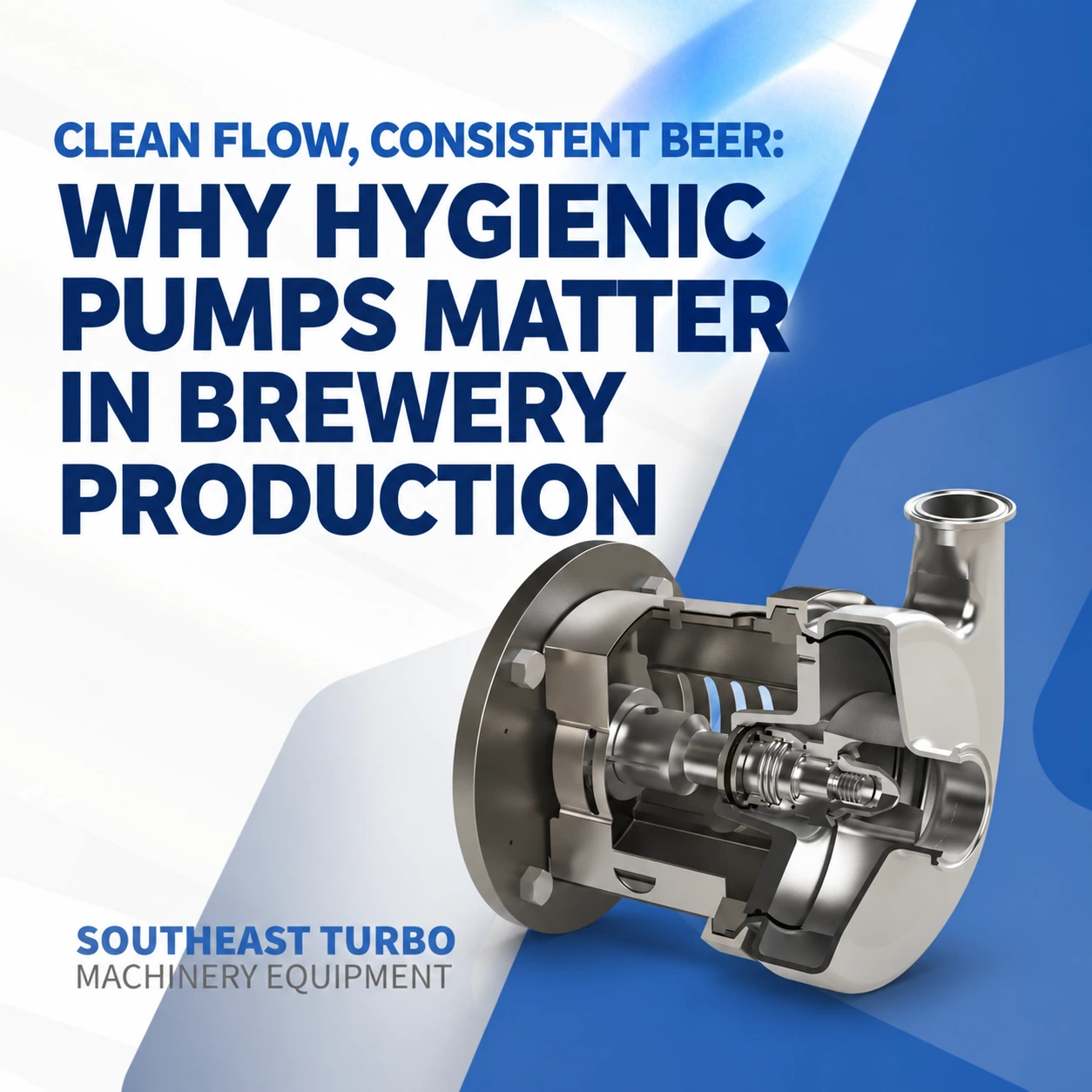
Brewing depends on controlled fluid movement from the brewhouse through fermentation, conditioning, cleaning, and packaging. Wort, finished beer, process water, and cleaning solutions all need to move at the right flow and pressure while the equipment handling them remains cleanable and compatible with the process.
That makes hygienic pumps an important part of brewery performance. The right pump does more than transfer liquid between vessels. It can help maintain repeatable processing, protect product quality, support sanitation, limit unnecessary product loss, and reduce interruptions that affect the brewing schedule.
For breweries evaluating new equipment or addressing recurring transfer problems, pump selection should begin with the application itself: what is being moved, how it behaves, where it is going, how the system is cleaned, and how consistently production needs to run.
Hygienic pumps help breweries move wort, beer, water, and cleaning solutions under controlled sanitary conditions. Proper pump selection supports consistent flow, cleanability, product protection, reliable CIP circulation, controlled filtration and cooling, and dependable transfer into packaging equipment.
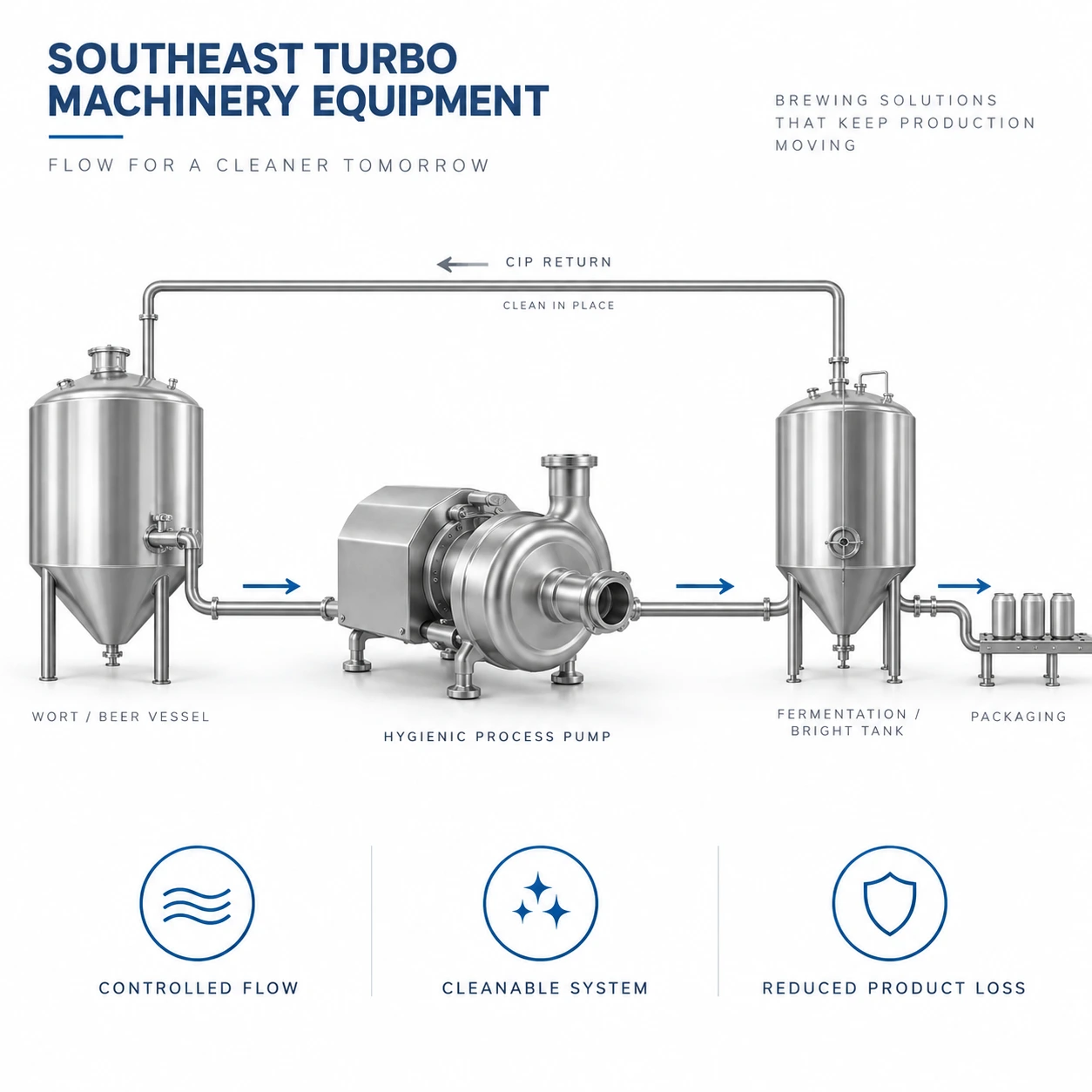
Wort moves through several important stages before fermentation begins. Depending on the brewery configuration, transfer may occur between mash equipment, the brew kettle, whirlpool, heat exchanger, and fermentation vessel.
Each transfer has a job to accomplish without unnecessarily disturbing the process. Pump performance that is too aggressive, unstable, or poorly controlled can make flow harder to manage and may create unwanted agitation or shear.
A brewery pump should therefore be evaluated around factors such as:
Stable transfer conditions help the brewhouse operate more predictably from one batch to the next. The goal is not simply to move wort quickly, but to move the required volume in a way that supports the process.
Breweries evaluating sanitary or process equipment can review STME's industrial and hygienic pump options as part of an application-based selection process.
Equipment that contacts wort, finished beer, process water, or cleaning solutions needs to be evaluated with cleanability in mind. Product residue trapped in difficult-to-clean areas can complicate sanitation and create avoidable production risk.
Important hygienic pump considerations can include:
These features should not be considered separately from pump performance. A pump may meet the required flow and pressure while still being poorly suited to the brewery if cleaning is difficult or the design leaves excessive product behind.
The strongest equipment choice balances hydraulic performance with the sanitation and maintenance requirements of the process.
Clean-in-place systems depend on predictable circulation. Pumps move water, caustic solutions, sanitizing fluids, and other cleaning media through tanks, piping, valves, and process equipment so the system can be cleaned without unnecessary disassembly.
The pump must provide the flow conditions required by the cleaning process while remaining compatible with the cleaning fluids and temperatures involved.
Poor CIP circulation can become a production issue as well as a sanitation concern. If equipment cannot be cleaned efficiently, changeovers may take longer and production assets may remain unavailable for the next batch.
Breweries should therefore consider CIP requirements when specifying production pumps rather than treating cleaning as a separate system after the equipment has already been selected.
For additional discussion of sanitary pump design and cleanability, STME's resource on sanitation-focused pumping systems explains how equipment selection can influence cleaning, reliability, and process performance.
After boiling, wort must be cooled to the required fermentation condition. Pumps support movement through heat exchangers and associated sanitary piping, where consistent flow contributes to predictable heat-transfer performance.
Unstable or insufficient flow can make the cooling process harder to control. Excessive flow may also create operating conditions that differ from what the heat exchanger and downstream process were designed to handle.
A cooling application should therefore be evaluated as a system that includes:
The pump should provide the flow the cooling process requires without unnecessary restriction, excess pressure, or unstable operation.
Filtration and clarification processes can be sensitive to changing flow and pressure. A pump that is poorly matched to the application may place unnecessary stress on filters or make the process more difficult to control.
Instead of treating the pump as an isolated transfer device, breweries should consider how its operating point interacts with the filtration equipment downstream.
Important questions include:
Answering those questions helps the brewery select equipment that supports the process instead of forcing the process to adapt to the pump.
Finished beer still needs controlled movement after fermentation and conditioning. Transfer from bright or conditioning tanks to canning, bottling, or kegging equipment needs to keep pace with the packaging operation without creating unnecessary interruption or product loss.
An unstable feed to packaging equipment can reduce line consistency and create delays even when the filling machine itself is operating correctly.
Packaging-related pump selection should consider:
Reliable transfer helps make packaging part of a continuous production process rather than another point where beer can be lost or schedules can slip.
Beer lost during transfer, equipment changeover, cleaning, or packaging is finished or partially finished product that cannot be sold. Small losses repeated across many batches can become an important operating-cost issue.
Pump and system design can influence product loss through factors such as:
A better-matched system can make fluid movement more predictable and reduce unnecessary loss without requiring the pump to operate harder than the process needs.
Larger pump capacity does not automatically create better performance. An oversized pump may produce more flow and pressure than the application requires, while an undersized pump may struggle to keep production moving during periods of higher demand.
Both conditions can create operating problems.
A sizing review should consider the complete duty rather than just a maximum flow number. That includes normal flow, peak demand, piping resistance, fluid characteristics, cleaning requirements, and how often operating conditions change.
Some brewery applications need different flow rates at different stages. A variable-speed drive can allow pump output to be adjusted more closely to actual process requirements instead of continuously operating at full speed and controlling flow through restriction.
Potential benefits can include:
Variable-speed operation should still be evaluated around the pump and application. The correct control strategy depends on how the brewery actually uses the equipment.
A pump failure can interrupt production at almost any stage. The business consequence depends on where the failure occurs and what other processes are waiting for that equipment.
Examples include:
Those disruptions can create more than repair cost. They may also produce lost production time, delayed batches, product waste, additional labor, and schedule pressure elsewhere in the brewery.
Pumps often show changes in operating behavior before they stop completely. Monitoring those changes gives maintenance teams an opportunity to investigate problems during planned service windows.
Useful indicators can include:
A change in one measurement does not always identify the cause by itself. Trends and repeat patterns are often more useful because they can show that the pump or surrounding system is behaving differently than it did under normal operation.
The objective is to identify developing reliability concerns early enough to plan corrective work before production is forced to stop.
Repeated pump failures do not necessarily mean the pump itself is fundamentally defective. The conditions surrounding the equipment may be contributing to the problem.
System factors can include:
Frequent seal failures, cavitation, unstable flow, excessive vibration, or unexpectedly high energy use should therefore trigger a broader review.
The useful question is not only, "What is wrong with this pump?" It is also, "What operating conditions is the system creating for the pump?"
That distinction can help breweries correct root causes rather than repeatedly replacing the same wear components.
The initial price of a brewery pump is only one part of its long-term cost. The equipment will also influence energy consumption, sanitation time, maintenance labor, replacement parts, product loss, production flexibility, and downtime exposure.
A stronger equipment evaluation considers:
A lower-cost pump may not provide the lowest lifecycle cost if it requires frequent service, complicates sanitation, wastes product, or cannot adapt to the brewery's process requirements.
Likewise, a properly selected pump may create value beyond the equipment room by helping production remain clean, consistent, and predictable.
A brewery's process requirements may change as production increases. Larger vessels, additional packaging capacity, new products, automation, or revised cleaning procedures can all affect pump duty.
That does not mean equipment should automatically be oversized for hypothetical future demand. Instead, future requirements should be considered alongside the brewery's current operating profile.
Useful questions include:
Planning around realistic growth can help avoid premature equipment replacement while still keeping the pump appropriately matched to current production.
Hygienic pumps influence nearly every major stage of brewery fluid handling. They support wort movement, cooling, CIP circulation, filtration, clarification, finished-beer transfer, and packaging while helping production teams maintain sanitary and predictable operating conditions.
The strongest pump selection is not based on maximum flow or purchase price alone. Fluid characteristics, flow, pressure, temperature, sanitary design, cleanability, suction conditions, controls, maintenance expectations, and future production all need to be considered together.
For breweries experiencing unstable flow, repeated pump repairs, sanitation challenges, product loss, or equipment that no longer matches production demand, a system-level review can help identify whether the next step is maintenance, an operating adjustment, a system change, or different pump equipment.
To discuss hygienic pump requirements for a brewery or sanitary processing application, contact Southeast Turbo Machinery Equipment.
Hygienic pumps can support wort transfer, cooling, clean-in-place circulation, filtration, clarification, water movement, finished-beer transfer, and packaging operations where controlled and cleanable fluid handling is required.
A brewery should consider fluid characteristics, required flow and pressure, temperature, suction conditions, sanitary design, cleanability, CIP requirements, operating schedule, maintenance access, and expected future production needs.
CIP compatibility allows cleaning fluids to circulate through the pump and connected sanitary system without unnecessary disassembly, helping breweries maintain clean process equipment and efficient production changeovers.
Variable-speed control can be useful where flow requirements change because pump output can be adjusted more closely to process demand, improving flow control while reducing unnecessary energy use and mechanical stress.
Repeated problems may be caused by suction conditions, piping, valves, tank elevation, operating speed, controls, cleaning practices, or changing process demand rather than the pump alone. A system review helps identify the root cause.

