Wine production depends on controlled fluid movement from the first stages of grape processing through fermentation, clarification, filtration, storage, and bottling. At each point, pumps must move juice, must, wine, water, and cleaning solutions without creating unnecessary product stress or making sanitation more difficult.
That makes pump selection an important production decision. A properly matched hygienic pump can help preserve wine quality, maintain consistent transfer conditions, reduce product loss, support cleaning, and keep production schedules moving. A poorly matched system may create excessive agitation, unstable flow, difficult cleaning, unnecessary energy use, or recurring maintenance problems.
For wineries focused on consistent quality and long-term operating value, the objective is not simply to move more liquid. It is to move the product cleanly, gently, predictably, and efficiently.
Hygienic pumps help wineries transfer grape juice, must, finished wine, process water, and cleaning solutions while supporting controlled flow and sanitary operation. Proper pump selection can help minimize unnecessary agitation, reduce product loss, simplify cleaning, maintain reliable production, and protect the characteristics of the wine throughout processing.
How wine moves through the process can matter as much as whether it reaches the next vessel. Fresh juice, must, and finished wine may be sensitive to unnecessary agitation, shear, and exposure to conditions that can influence product quality.
A winery pump should therefore be selected around the characteristics of the product and the requirements of the process rather than flow capacity alone.
Important factors may include:
A controlled transfer system gives winery teams more flexibility when moving product between crushing, fermentation, clarification, aging, filtration, storage, and bottling.
Facilities evaluating equipment for sanitary beverage applications can review STME's industrial and hygienic pump solutions as part of an application-focused pump review.
A winery does not necessarily need the same flow rate for every transfer. Moving freshly processed grape material may call for different operating conditions than moving clarified wine into storage or supplying a bottling process.
Running a pump at one fixed operating point regardless of the application can make control more difficult and may create more flow or pressure than the process requires.
Where the pump and application are suitable, variable-speed control can allow operators to adjust pump output to different process requirements.
This may help provide:
The correct speed still depends on the process. The objective is not simply to slow the pump down, but to operate it at a condition that supports the required flow while maintaining reliable performance.
A pump can meet the required flow and pressure and still be poorly suited to winemaking if it is difficult to clean.
Sanitation is an operating requirement throughout beverage processing. Any equipment that contacts juice, wine, water, or cleaning solutions should be evaluated for its ability to support predictable cleaning between production stages.
Important hygienic design considerations may include:
The objective is to limit areas where residual product can collect and make cleaning more difficult.
STME's resource on sanitation-focused pumping systems provides additional perspective on how cleanability, equipment design, and operating performance work together in sanitary processing applications.
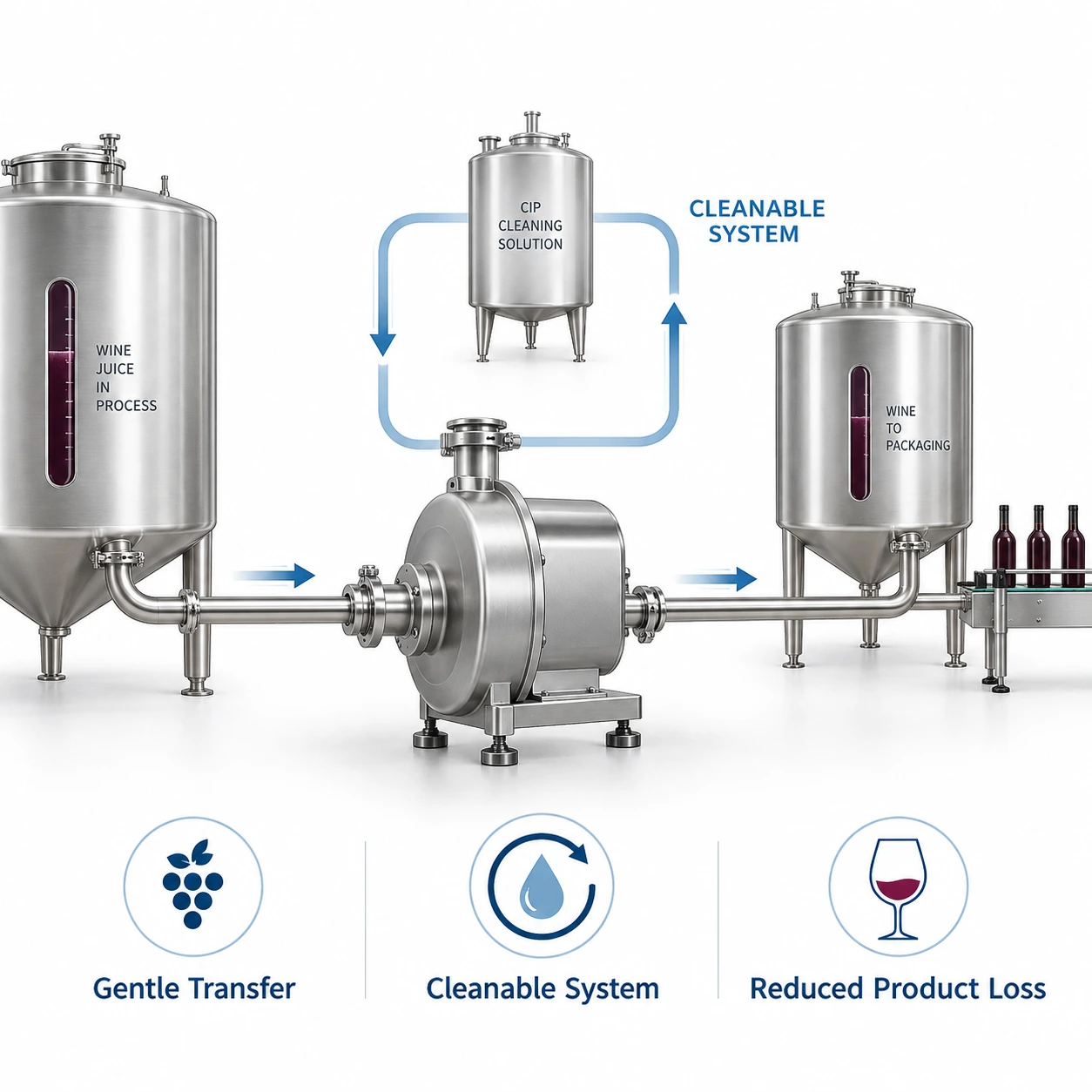
Clean-in-place systems depend on controlled circulation through tanks, piping, valves, and process equipment. Pumps help move water and cleaning solutions through the sanitary system so production equipment can be prepared for the next batch or product change.
The cleaning duty should be considered when selecting the pump rather than treated as a separate issue after installation.
A winery may need to evaluate:
Reliable cleaning circulation can help reduce sanitation delays and make equipment availability more predictable between production stages.
Product lost during transfer, draining, cleaning, or bottling is product that cannot be sold. Even relatively small losses can become significant when they repeat across many vessels, batches, and production runs.
Pumping-system design can influence usable yield through factors such as:
A well-matched system helps move more product predictably from one process stage to the next without requiring excessive pressure or flow.
That makes product recovery an important part of pump economics. A pump should be evaluated not only by whether it runs reliably, but also by how effectively the complete system protects the wine being moved.
Filtration and clarification processes often depend on controlled pressure and flow. If the pump delivers unstable or excessive conditions, downstream equipment may become harder to operate consistently.
Winery teams should consider the relationship between the pump and the filtration process rather than treating them as independent pieces of equipment.
Useful questions include:
Matching pump performance to the downstream process can help maintain more predictable operation while limiting unnecessary mechanical or process stress.
Bottling is one of the final stages where pump performance can affect both production efficiency and usable yield.
Finished wine needs to move from storage or conditioning vessels toward the bottling process at a controlled rate. Unstable transfer can create interruptions, reduce line consistency, or contribute to unnecessary product loss.
A bottling-transfer application should consider:
A reliable pump helps the winery maintain production continuity from the cellar through final packaging.
Winemaking is highly dependent on timing. A pump failure can create consequences beyond the cost of repairing the equipment itself.
A transfer failure may delay movement into the next vessel. A filtration pump problem may hold up downstream processing. A cleaning-system failure may prevent equipment from returning to production. A bottling-transfer problem can disrupt packaging schedules.
Potential consequences include:
Reliable equipment gives winery teams more control over those schedules and reduces the likelihood that one pump becomes a bottleneck for multiple process stages.
Many pump problems develop gradually. Changes in operating behavior can provide warning before the equipment stops completely.
Useful indicators may include:
Trends are particularly valuable. A gradual increase in vibration, recurring seal leakage, changes in flow, or more frequent maintenance may indicate that the pump or the surrounding system deserves closer investigation.
The goal is to identify developing issues early enough to plan service before production is interrupted.
When the same pump repeatedly experiences problems, replacing components may restore operation without eliminating the underlying cause.
Pump performance can be affected by:
Frequent seal failures, cavitation, unstable flow, excessive vibration, or unexpectedly high energy consumption should therefore trigger a system-level review.
Instead of asking only what is wrong with the pump, winery teams should also ask what conditions the system is creating for the pump.
That approach helps identify root causes rather than repeatedly replacing wear components while leaving the original operating problem unchanged.
A pump's purchase price is only one part of its true cost to a winery. Long-term value also depends on how the equipment influences product recovery, sanitation, maintenance, energy use, production flexibility, and downtime.
A lifecycle evaluation can include:
A lower-priced pump may become more expensive over time if it creates sanitation problems, wastes product, requires repeated repairs, or cannot adapt to changing process needs.
The stronger equipment decision is the one that supports the winery's complete operating requirement rather than simply minimizing the initial purchase cost.
Production requirements can change as a winery expands. Larger fermentation vessels, more storage, new filtration equipment, additional wine styles, higher bottling throughput, or increased automation can all change pump duty.
Planning for those changes does not mean automatically installing oversized equipment today. It means understanding the expected operating range and selecting equipment that can accommodate realistic process requirements.
Useful planning questions include:
Matching equipment to realistic growth can reduce premature replacement without compromising current efficiency or product handling.
From grape processing and fermentation to filtration, storage, sanitation, and bottling, pumps influence product movement throughout winery production.
The right hygienic pumping system helps wineries maintain controlled transfer, protect product quality, reduce avoidable loss, simplify cleaning, and keep production schedules moving. Achieving that performance requires more than selecting equipment by horsepower or maximum flow.
Flow, pressure, temperature, fluid characteristics, suction conditions, cleanability, control strategy, maintenance expectations, and future production requirements should all be considered together.
For wineries experiencing unstable flow, recurring pump failures, sanitation challenges, excessive product loss, or equipment that no longer matches production requirements, evaluating the complete system can help identify the most practical next step.
To discuss hygienic pump requirements for winery or beverage-processing applications, contact Southeast Turbo Machinery Equipment.
Hygienic pumps can support grape juice and wine transfer, fermentation-stage movement, filtration, clarification, clean-in-place circulation, storage transfer, and bottling operations where controlled and cleanable fluid handling is required.
A winery should consider product characteristics, required flow and pressure, temperature, suction conditions, sanitary design, cleanability, cleaning requirements, operating schedule, maintenance needs, and expected future production.
A properly matched pumping system can improve transfer control, reduce leaks and unnecessary product hold-up, improve drainability, and limit avoidable losses during transfer, cleaning, and packaging.
CIP compatibility helps cleaning solutions circulate through the pump and sanitary piping without unnecessary disassembly, supporting more predictable sanitation and faster preparation between production stages.
Recurring problems may be caused by suction conditions, tank elevation, piping, valves, operating speed, controls, cleaning procedures, or changing process requirements rather than the pump alone. A system evaluation helps identify the root cause.

