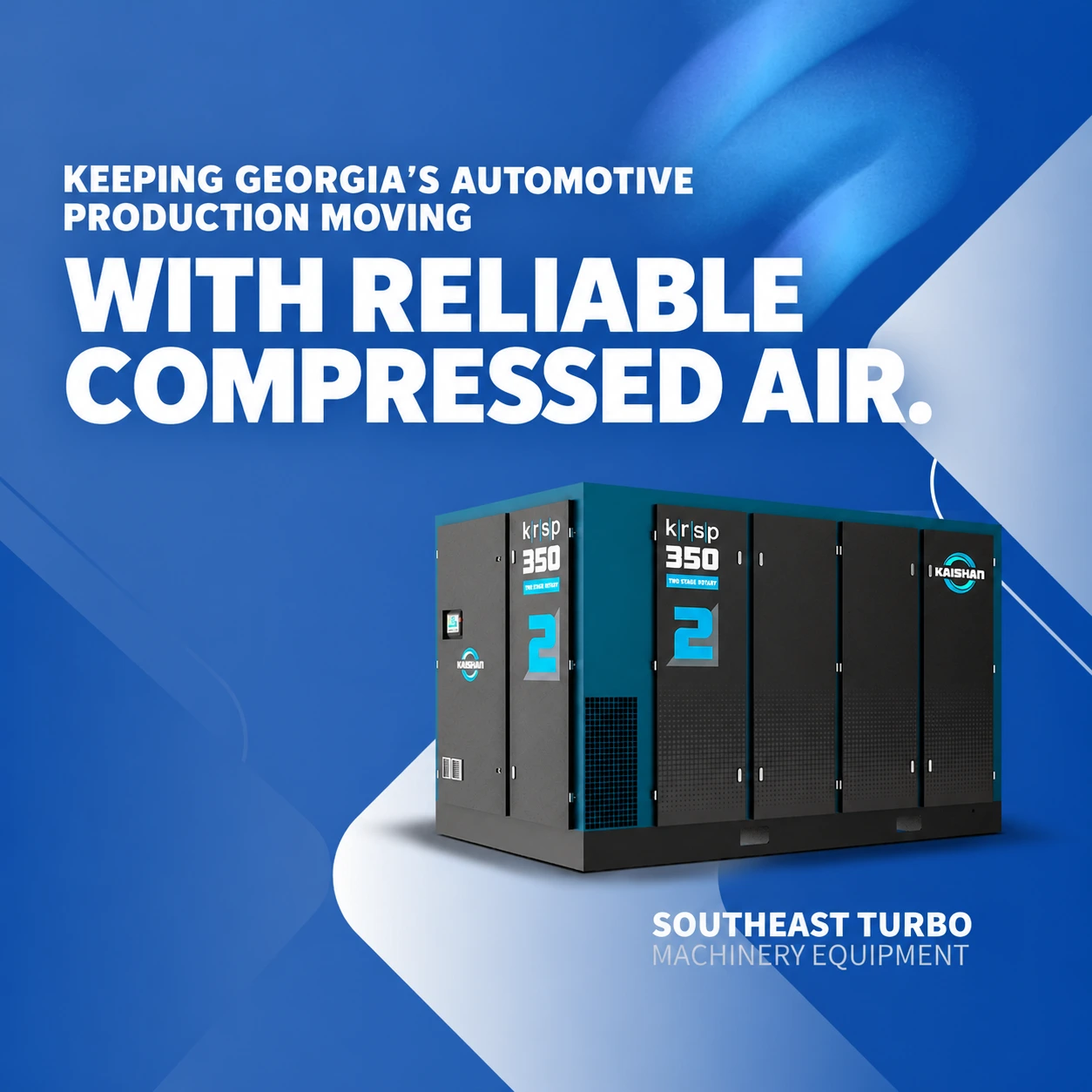
Automotive production does not require a complete compressor shutdown for compressed air problems to disrupt a shift. A pneumatic clamp that responds slowly, a tool that loses power during peak demand, unstable pressure at an assembly station, or moisture reaching sensitive equipment can all interfere with production even while the compressor itself continues running.
For Georgia automotive manufacturers and suppliers, dependable compressed air requires more than selecting enough compressor horsepower. Airflow demand, pressure at the point of use, receiver storage, piping, controls, drying, filtration, leaks, maintenance, and production schedules all influence what ultimately reaches the plant floor.
The objective is not simply to produce more compressed air. It is to deliver the required amount of clean, usable air at the correct pressure when production needs it, without creating unnecessary energy use or masking problems elsewhere in the system.
A reliable automotive compressed air system matches compressor capacity, pressure, storage, air treatment, controls, and distribution to the facility's actual operating demand. The system should maintain usable pressure at critical equipment during normal production and short-term peaks while controlling moisture, limiting unnecessary pressure loss, and avoiding inefficient compressor operation.
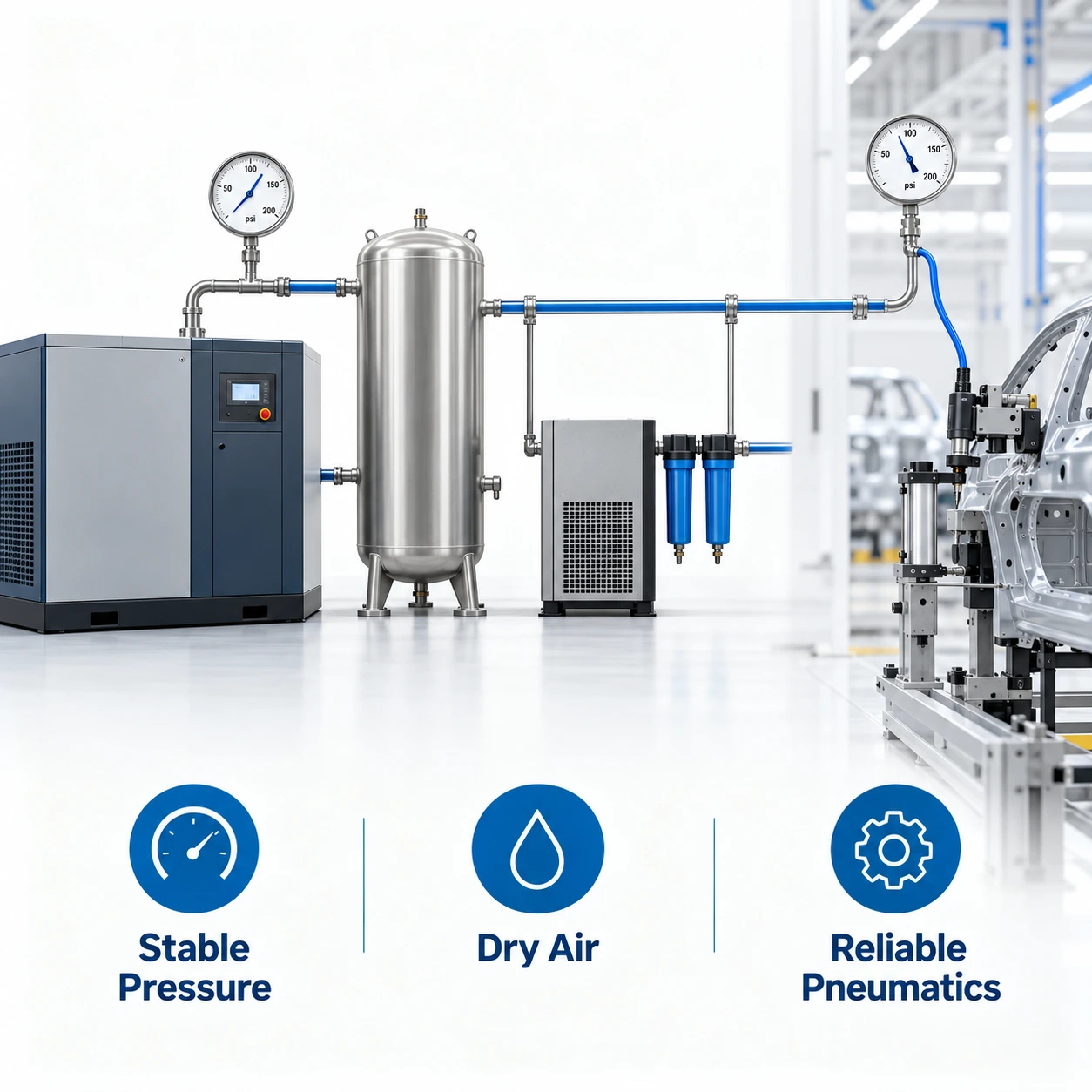
Replacing an existing compressor with a larger unit is not the same as properly sizing a compressed air system. An undersized compressor may struggle when sustained demand exceeds available capacity. An oversized compressor can also create problems if its control strategy causes inefficient unloaded operation, excessive cycling, or poor part-load performance.
A stronger sizing process begins with understanding how the plant actually uses air.
Three measurements are especially useful:
Measurements should reflect more than one operating condition. Startup, normal production, shift changes, equipment changeovers, packaging or assembly peaks, maintenance periods, and idle time may create very different demand profiles.
Facilities evaluating new or replacement equipment can review STME's industrial compressors and compressed air systems as part of an application-based system review.
A normal pressure reading in the compressor room does not prove that an assembly station receives adequate pressure under load. Air still has to travel through receivers, dryers, filters, headers, branch piping, valves, fittings, hoses, and point-of-use components before reaching the pneumatic device.
Every restriction creates the potential for pressure loss. The effect can become more noticeable when several air-consuming devices operate at the same time.
Comparing pressure at the supply side with pressure at critical production equipment can help maintenance teams determine whether the issue is compressor capacity or distribution performance.
Useful locations for comparison may include:
The important measurement is not simply static system pressure. It is the pressure available while the process is consuming air.
A slow pneumatic tool, weak actuator, or delayed clamp can appear to be a capacity problem even when the plant already produces enough compressed air.
Potential causes of reduced point-of-use pressure include:
These restrictions may remain difficult to notice during low demand and become obvious only when multiple machines cycle together.
Raising compressor discharge pressure throughout the plant to compensate for one restricted area may increase compressor work without correcting the underlying problem. A better approach is to identify where pressure is being lost and correct the restriction where practical.
After repairs, repeat the measurements. Compare point-of-use pressure, compressor loading behavior, and power consumption under similar production conditions. The objective is to verify that the change actually improved delivered performance rather than simply changing how the compressor operates.
Air that escapes through a leak still has to be compressed. As leakage increases, compressors may operate longer, load more frequently, or struggle to maintain pressure during production peaks.
Leaks can develop in:
A plant with growing leakage may appear to need additional compressor capacity even though productive air demand has not increased. Leak identification and repair should therefore be part of the system evaluation before major equipment decisions are made.
Automotive air demand can change quickly as production equipment cycles. A system designed only around average airflow may experience pressure problems during short peaks, while a system sized entirely around an occasional maximum may operate inefficiently during normal demand.
Fixed-speed compressors can be effective where a plant has stable base demand and the equipment can operate near an appropriate loading condition.
Variable-speed equipment can be useful where airflow demand changes substantially and the compressor can operate within an appropriate control range. Output can follow changing demand more closely rather than relying entirely on fixed-capacity operation.
Some facilities may benefit from combining compressor types or sequencing multiple machines so base demand and changing loads are handled more deliberately.
The correct arrangement depends on the actual load profile, operating hours, control strategy, redundancy requirements, and expected production growth. Related guidance on air compressor reliability and lifecycle operating decisions can provide additional perspective when evaluating long-term equipment performance.
Air receivers provide stored compressed air that can help a system respond to brief demand spikes and stabilize pressure. That can be useful when pneumatic equipment cycles rapidly or several devices require air at approximately the same time.
Storage, however, is not unlimited capacity.
A receiver must eventually be recharged by the compressor system. If demand remains above available compressor output for an extended period, additional storage alone cannot solve the shortage.
That distinction matters when diagnosing pressure problems:
Receiver sizing should therefore be considered together with compressor capacity, acceptable pressure range, controls, and the duration of production peaks.
Georgia's warm, humid conditions can place additional importance on compressed air moisture control. Atmospheric air entering the compressor contains water vapor. As compressed air cools, moisture can condense unless the system is designed and maintained to manage it.
Excess moisture can contribute to corrosion, equipment wear, unreliable pneumatic operation, and problems in applications that require drier air.
Dryer selection should consider:
Refrigerated dryers may be appropriate for general plant-air applications where moderate moisture removal is sufficient. Processes requiring substantially lower dew points may require desiccant drying or another treatment approach suited to the required air quality.
Dryers and filters should also be understood as different parts of the treatment system. Removing liquid water or particles does not automatically remove water vapor to the required level.
Air quality should therefore be specified by application. Drains, separators, filters, and dryers must also remain maintained so the treatment system continues performing as intended.
A compressor can remain operational while its performance changes. Monitoring gives maintenance teams a way to identify those changes before they become larger production issues.
Useful measurements can include:
These measurements become more meaningful when compared with production activity. Longer compressor runtime without additional production demand may justify a leak or system-efficiency investigation. Repeated pressure dips may indicate changing demand, inadequate storage, restrictions, controls, or available-capacity problems.
Trends should be treated as diagnostic clues rather than automatic conclusions. Manufacturer-recommended service, cooling-system inspection, drain maintenance, filter condition, ventilation, and operator observations should remain part of routine compressor management.
There is no single repair-cost percentage that determines whether every compressor should be repaired or replaced. The stronger decision considers equipment condition, production requirements, recurring failures, parts availability, energy use, maintenance history, and downtime exposure.
Repair may remain reasonable when:
Replacement may deserve closer consideration when:
Compare both options across a similar time horizon. Consider electricity, service, parts, installation, temporary air requirements, and the operating consequences of downtime.
Most importantly, determine whether the compressor itself is the root cause. Replacing equipment will not correct undersized piping, excessive leakage, restrictive treatment equipment, or poorly coordinated system controls.
Compressed air is versatile, but that does not mean it should perform every task simply because an air connection is available.
For example, in an appropriate parts-washing or fluid-handling process, a pump may circulate process liquid while compressed air operates valves, actuators, clamps, or other pneumatic devices. Assigning each machine to the work it is designed to perform can reduce unnecessary compressed air demand and simplify system planning.
Facilities evaluating liquid-handling applications alongside compressed air can review STME's industrial pump solutions to compare equipment roles within the larger production process.
Production requirements rarely remain static. New automation, additional assembly equipment, changes in shift schedules, new tooling, or expansion into additional production areas can change the facility's airflow profile.
Future needs should be included in compressor planning, but confirmed expansion should be separated from hypothetical demand. Installing unnecessary capacity today can create its own operating inefficiencies.
A practical growth review should consider:
The objective is a system that can support realistic production growth without sacrificing current efficiency or pressure stability.
Reliable compressed air in automotive manufacturing depends on much more than compressor horsepower. Airflow demand, pressure at the point of use, leaks, piping restrictions, controls, receiver storage, air treatment, maintenance, and production schedules all influence the performance of the complete system.
Before adding capacity, determine why production equipment is not receiving the air it needs. Before raising pressure, identify restrictions. Before replacing a compressor, verify whether the problem begins with the compressor or somewhere else in the supply-to-use path.
For Georgia automotive manufacturers experiencing pressure instability, moisture problems, increasing runtime, recurring compressor issues, or production growth that is changing compressed air demand, a system-level review can help clarify the next step.
To discuss compressed air requirements for an automotive manufacturing or supplier facility, contact Southeast Turbo Machinery Equipment.
Compressor sizing should consider average and peak airflow demand, required pressure, how long demand peaks last, simultaneous equipment use, production schedules, existing storage, pressure losses, air-quality requirements, and realistic future expansion.
Pressure can be lost between the compressor and the equipment through undersized piping, long distribution runs, restrictive fittings, dirty filters, hoses, valves, leaks, or other components. Pressure should be checked at the point of use while the equipment is operating.
An air receiver provides stored compressed air that can help stabilize pressure and support short-duration demand peaks. It cannot replace compressor capacity when demand remains above available supply for an extended period.
Warm, humid air can introduce significant water vapor into a compressed air system. Without appropriate drying, drainage, filtration, and maintenance, moisture can contribute to corrosion, equipment wear, and problems in moisture-sensitive pneumatic applications.
Repair may remain appropriate when the failure is isolated, parts are available, the compressor still matches the application's demand, and the surrounding system remains suitable. Replacement deserves closer evaluation when failures recur, support becomes difficult, or production requirements have changed.

