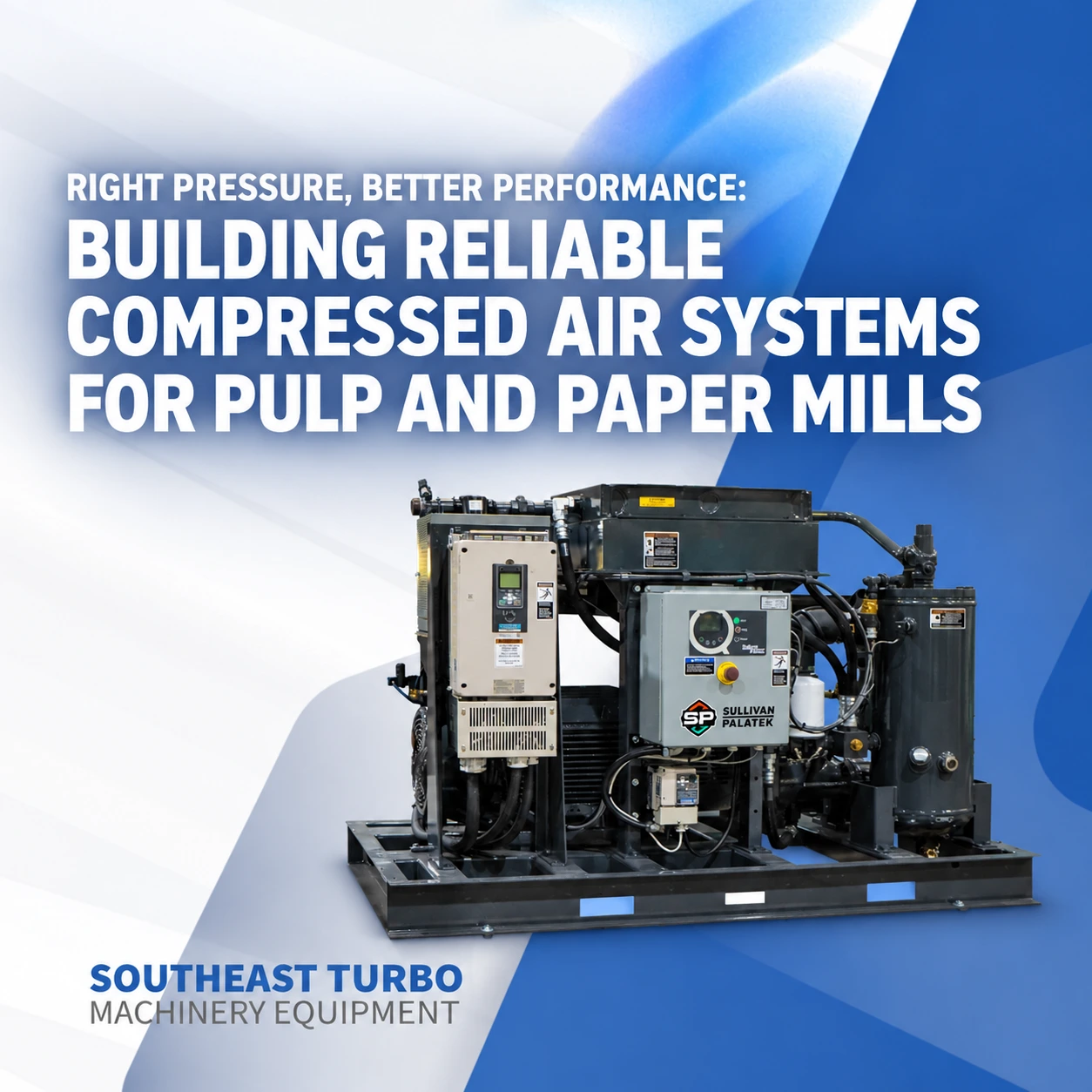
Pulp and paper mills depend on continuous production, and compressed air supports many of the systems that keep that production moving. Pneumatic controls, actuators, instrumentation, automation, material handling, air knives, and maintenance tools all rely on a stable air supply.
That makes compressed air more than a supporting utility. If plant pressure becomes unstable or compressor capacity no longer matches demand, the effects can appear throughout the operation. Controls may respond inconsistently, energy consumption can rise, maintenance demands may increase, and production can become more vulnerable to unplanned interruptions.
The objective is not simply to generate more compressed air. A well-designed system should deliver the airflow production actually needs, at the required pressure and air quality, while limiting unnecessary energy use and equipment stress.
A reliable compressed air system matches compressor capacity, operating pressure, storage, air treatment, controls, and distribution to the mill's actual demand. Proper sizing and system-level evaluation help maintain stable pressure while reducing excessive cycling, wasted energy, premature equipment wear, and the risk of unexpected downtime.
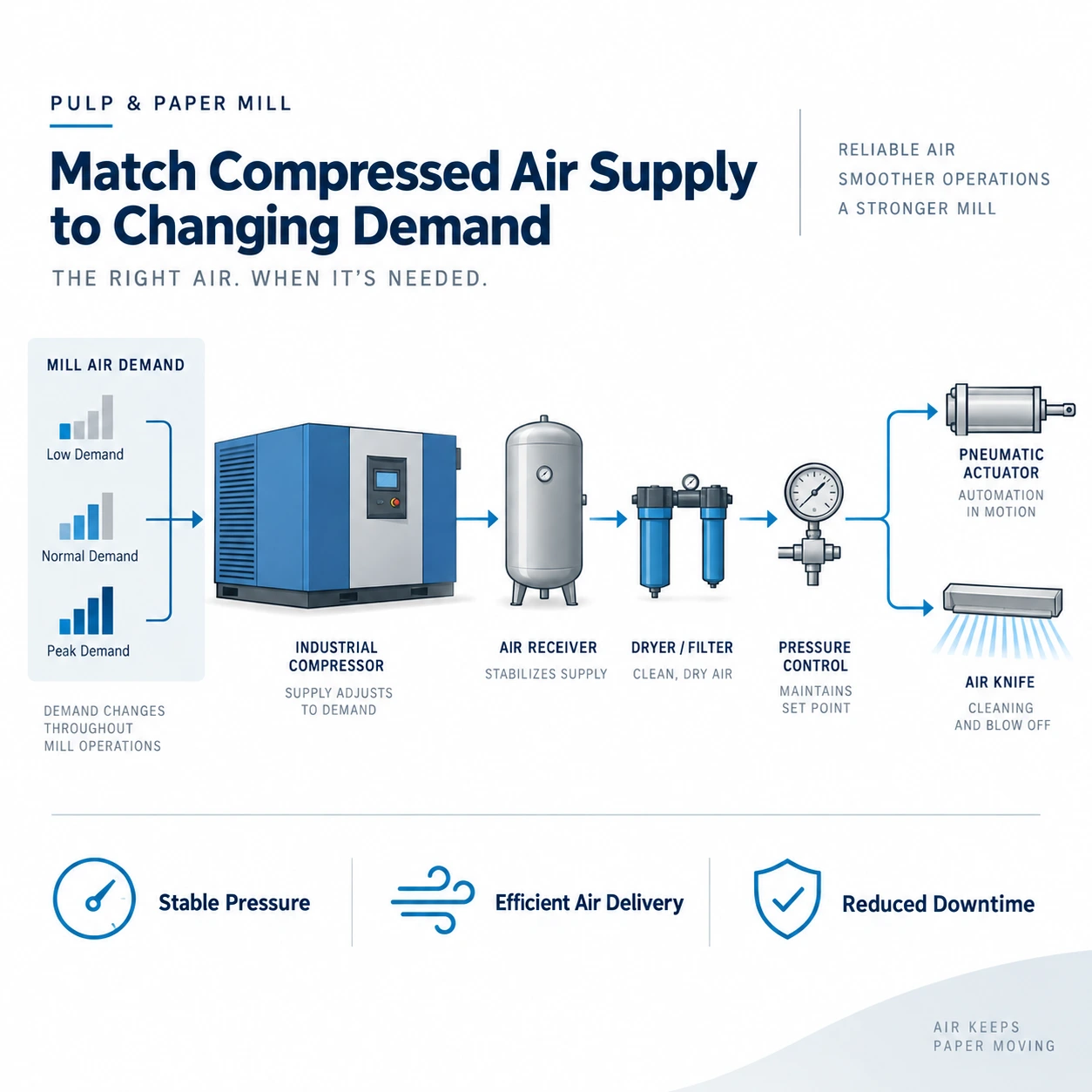
Installing a larger compressor does not automatically make a compressed air system more reliable. The equipment must be matched to the way the mill actually consumes air.
An oversized compressor may spend too much time operating inefficiently at partial load or cycling more often than necessary. An undersized compressor may run continuously and still struggle to maintain pressure when demand increases.
A practical sizing review should consider:
Facilities evaluating new or replacement equipment can review STME's industrial compressor and compressed air solutions as part of an application-focused system review.
The goal is to provide enough capacity for production without purchasing and operating capacity the mill rarely uses.
A mill experiencing low pressure may assume that it needs a larger compressor. In some cases, however, the real problem exists elsewhere in the air system.
System conditions that can reduce usable compressed air include:
These losses can force compressors to run longer or at higher pressure even though the underlying production demand has not changed.
That is why replacing an existing compressor with another unit of similar horsepower does not necessarily solve recurring pressure or efficiency problems. The complete compressed air system should be evaluated before additional capacity is assumed to be the answer.
Pulp and paper mills rarely use the same amount of compressed air every minute of the day. Production equipment cycles, different lines operate at different times, and maintenance activities may create temporary peaks in demand.
The compressor strategy should account for those changes.
Variable-speed compressors can be effective where airflow demand changes substantially. By adjusting compressor output more closely to actual demand, the system can reduce the amount of unnecessary air production during lower-load periods.
However, variable-speed operation is not automatically the most efficient solution for every plant. A mill with stable, continuous demand may be better served by fixed-speed equipment, while another facility may benefit from a combination of fixed-speed and variable-speed compressors.
Short-duration peaks do not always require more compressor horsepower. Adequate storage can help the system respond to temporary increases in demand, while sequencing controls can coordinate multiple compressors more effectively.
The strongest configuration depends on the mill's actual load profile rather than a single equipment technology.
Compressed air requires electrical energy to produce, making inefficient operation a meaningful operating-cost issue for mills with high compressor runtime.
The challenge is that waste can remain hidden while production continues normally.
Common contributors include:
A compressor can therefore appear to be performing correctly while using more electricity than necessary.
One particularly important issue is operating the entire system at higher pressure than end-use equipment requires. Higher system pressure can increase compressor workload while also increasing losses through leaks.
The objective should be to deliver usable compressed air efficiently to the point of use, not simply to create pressure at the compressor discharge.
The compressor is only one part of the system. Receivers, dryers, filters, drains, piping, valves, controls, and downstream equipment all affect the quality and efficiency of the air delivered to production.
These components deserve attention because each can influence system pressure and compressor workload.
An efficient compressor connected to an inefficient distribution system may never achieve the expected system performance.
Performance monitoring gives maintenance teams a clearer picture of what is happening inside the compressed air system before a major failure occurs.
Useful indicators may include:
The value often comes from changes in those measurements rather than any single reading.
For example, increasing compressor runtime without a corresponding increase in production may point toward additional leaks or declining system efficiency. Repeated pressure fluctuations may suggest insufficient storage, control problems, capacity limitations, or temporary demand spikes.
Higher operating temperature may signal cooling-system problems, dirty components, ventilation limitations, or a developing mechanical concern.
Monitoring does not replace preventive maintenance. Instead, it gives maintenance teams better information about when corrective work may be needed and where attention should be focused.
Reactive compressor maintenance places the production schedule in control of the repair. When equipment fails unexpectedly, maintenance teams may need to respond immediately regardless of other planned work.
Condition-based maintenance helps move some of those decisions earlier.
By reviewing changes in operating temperature, pressure, cycling, runtime, energy use, and service history, teams can identify equipment that may require attention before a complete failure occurs.
That creates an opportunity to:
STME's discussion of air compressor reliability and long-term operating value further explores how equipment performance and maintenance history influence lifecycle decisions in demanding industrial environments.
Purchase price is only one component of compressor cost. In facilities where equipment accumulates substantial runtime, operating expense can become equally important to the financial decision.
A lifecycle evaluation should consider:
A lower-priced compressor can become more expensive over time if energy consumption, repair frequency, or downtime exposure is significantly higher. Conversely, higher-efficiency equipment may justify a larger initial investment when operating savings and reliability are considered across its service life.
The strongest decision is therefore based on the cost of delivering the required air reliably over time, not simply on the initial purchase price.
Improving compressor efficiency can support both operating-cost control and broader sustainability objectives because reducing wasted compressed air also reduces unnecessary electrical demand.
Practical improvement opportunities may include:
Reliability is part of the same equation. Extending useful equipment life can reduce premature replacement, while planned maintenance can help prevent larger failures and associated production disruption.
An efficient compressor that repeatedly fails does not create strong operating value. Neither does a dependable compressor that consistently consumes more electricity than the application requires. The target is dependable performance with efficient resource use.
There is no single repair-cost percentage or equipment age that determines whether replacement is the correct decision for every pulp and paper mill.
Repair may remain appropriate when:
Replacement deserves closer consideration when:
Downtime risk should also be part of the evaluation. The financial impact of compressor failure may include production losses, overtime, schedule disruption, and delayed shipments in addition to the cost of repairing the machine.
Monitoring technology and efficient compressor equipment cannot replace informed plant personnel.
Routine attention still matters. Maintenance practices may include:
Operators can also provide valuable early warning by reporting unusual compressor cycling, pressure changes, abnormal sounds, excess heat, or production equipment that suddenly appears to require more air.
Reliable compressed air comes from the combination of proper equipment selection, system design, monitoring, maintenance, and informed day-to-day operation.
Pulp and paper facilities in Georgia and Florida need compressed air systems capable of supporting continuous production while controlling energy and maintenance costs.
Proper sizing establishes the foundation. Storage helps manage short-duration peaks. Air treatment protects required air quality. Controls coordinate equipment response. Monitoring improves visibility. Preventive and condition-based maintenance help reduce unexpected failures.
Most importantly, these elements should be evaluated together.
A pressure problem does not always require a larger compressor. An energy problem may not originate with the compressor itself. Repeated failures may reflect system conditions rather than an isolated equipment defect.
Looking at the complete compressed air system gives maintenance and operations teams a better chance of correcting the root cause rather than repeatedly addressing symptoms.
The most valuable compressor for a pulp and paper mill is not automatically the largest machine or the lowest-cost option. It is the equipment and system configuration that delivers the airflow production actually requires at the necessary pressure, air quality, reliability, and lifecycle cost.
For mills experiencing unstable pressure, rising electricity consumption, frequent compressor repairs, excessive cycling, or changing production requirements, a system-level evaluation can help determine whether the problem involves capacity, storage, treatment, controls, distribution, maintenance, or the compressor itself.
To discuss compressed air requirements for a pulp and paper application, contact Southeast Turbo Machinery Equipment.
Compressed air can support pneumatic controls, actuators, instrumentation, automation, material handling, air knives, maintenance tools, and other air-dependent equipment throughout pulp and paper production.
Compressor sizing should consider average and peak airflow demand, required pressure, duty cycle, production shifts, load variation, air quality requirements, operating conditions, system losses, and expected future demand.
Pressure problems can result from insufficient capacity, air leaks, undersized piping, restrictive filters, inadequate storage, demand spikes, poor controls, excessive pressure drop, or improper compressor sequencing.
Mills can reduce unnecessary energy use by repairing leaks, optimizing pressure settings, matching compressor output to demand, maintaining filters and dryers, improving storage and controls, and correcting excessive pressure losses.
Replacement may deserve consideration when failures become frequent, energy use rises, stable pressure becomes difficult to maintain, major components are nearing end of life, parts availability declines, production demand outgrows the equipment, or recurring repairs increase lifecycle cost.

