Georgia’s agricultural and food processing operations depend on equipment that can keep production moving through demanding schedules. Peanut processors, poultry plants, meat processing facilities, and other high-output operations rely on compressed air for conveying, packaging, automation, controls, pneumatic tools, and material handling.
When compressed air is stable, those processes can operate with fewer interruptions. When compressor performance declines, the effects can spread across production through pressure problems, emergency maintenance, higher energy use, and lost operating time. The strongest compressed air strategy therefore addresses reliability and efficiency together rather than treating them as separate objectives.
Reliable compressors provide the stable air supply needed to operate pneumatic equipment, conveying systems, packaging lines, controls, automation, and other air-dependent processes. When compressor capacity, pressure, controls, storage, and maintenance are matched to actual plant demand, facilities can protect uptime while reducing unnecessary energy use and equipment stress.
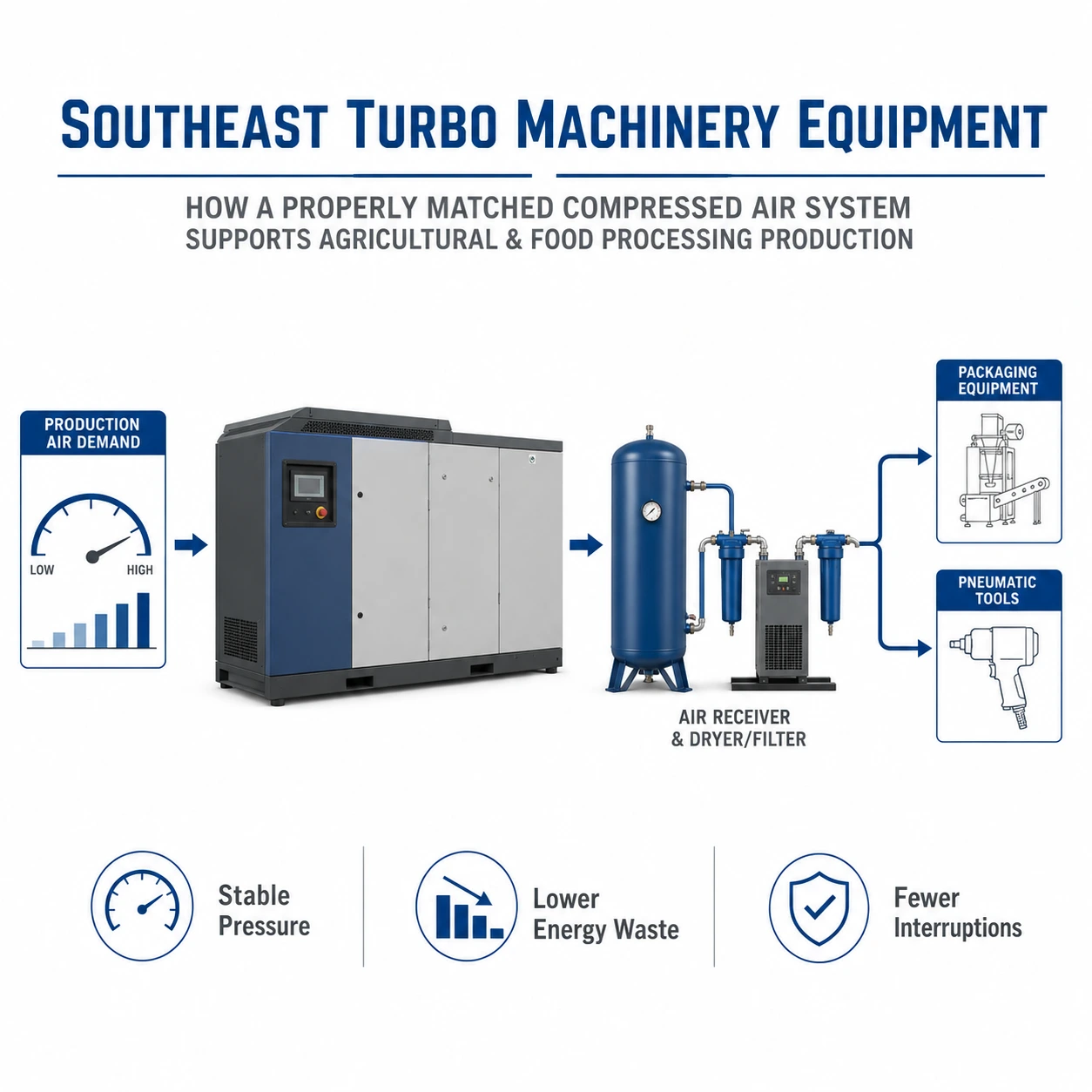
Compressed air often serves several processes at the same time. In peanut processing, it may support pneumatic conveying, sorting equipment, packaging systems, and controls. Poultry and meat processing operations may rely on compressed air for automation, pneumatic tools, and material handling.
This means one compressor problem can affect multiple parts of the operation. A loss of pressure or an unexpected shutdown can interrupt more than a single machine.
Common consequences of unreliable compressed air include:
Emergency repairs also create a secondary maintenance problem. When technicians are redirected toward an unexpected compressor failure, preventive work elsewhere in the facility may be delayed.
Facilities reviewing their air supply can start with STME’s industrial compressors and compressed air systems to consider equipment options in the context of the application rather than capacity alone.
A compressor should be selected around how the facility actually uses compressed air. Nameplate capacity by itself does not provide enough information to determine whether equipment is appropriate for a production environment.
Important sizing considerations include:
Oversizing and undersizing can create different problems. An oversized compressor may cycle inefficiently or produce more capacity than the plant regularly needs. An undersized unit may operate continuously and still struggle to maintain required pressure during periods of peak demand.
The objective is not to install the largest compressor available. It is to provide enough capacity to satisfy production requirements while allowing the system to operate predictably and efficiently.
Compressors can accumulate substantial operating hours over the course of a year. As a result, seemingly minor system inefficiencies can become meaningful energy expenses when they continue shift after shift.
Common sources of compressed air waste include:
A system can therefore appear functional while using more electricity than necessary. The fact that production equipment still receives air does not mean the compressed air system is operating efficiently.
Improvement begins with understanding actual demand rather than assuming the compressor is the only variable that matters.
A useful compressed air assessment compares supply with actual production demand. Facilities should look at how airflow and pressure requirements change during different shifts, processes, and production conditions.
Key areas to evaluate include:
Where air demand varies substantially, variable-speed compressor operation may help align output more closely with actual demand. In other systems, addressing leaks, storage limitations, controls, or unnecessarily high pressure may provide meaningful improvement without simply adding compressor capacity.
Energy efficiency should not mean restricting the air production needs. It means producing and distributing the compressed air the process requires without avoidable power consumption.
Pressure instability can become a production problem when pneumatic equipment depends on predictable air supply. If pressure repeatedly drops as demand increases, operators may experience inconsistent tool performance, interruptions in automated equipment, or problems with air-dependent processes.
Raising compressor discharge pressure may appear to solve the immediate problem, but it can also mask losses elsewhere in the system. Pressure drop caused by restrictive piping, dirty filters, inadequate storage, or distribution problems should be investigated before higher pressure becomes the default solution.
Stable pressure comes from balancing air generation, storage, treatment, distribution, and end-use demand rather than relying on the compressor alone.
Waiting until a compressor stops running can make maintenance more expensive and disruptive. Emergency failures create unplanned labor, rushed troubleshooting, and production risk that could otherwise be addressed during scheduled service.
Condition-based maintenance focuses on identifying changes before they become shutdowns. Maintenance teams can monitor indicators such as:
The individual reading is not always the most important factor. Changes over time can provide useful clues about how the equipment or system is behaving.
For example, increasing cycle frequency may point toward air leaks, changing demand, control problems, or insufficient storage. Rising operating temperature may indicate cooling limitations, dirty components, or a developing mechanical issue.
Equipment does not have to fail completely to become an operating liability. An aging compressor may continue supplying air while gradually consuming more power, requiring more repairs, or becoming less predictable.
Operations teams should look beyond the simple question of whether the compressor is running. More useful questions include:
Evaluating those trends can help facilities plan service or replacement decisions before an emergency shutdown forces the issue.
STME’s article on compressor maintenance and sustainable production further explains how preventive attention can support uptime, energy performance, and equipment life in demanding industrial applications.
Compressed air sustainability is closely tied to reliability. A system with uncontrolled leaks, excessive pressure, repeated cycling, or neglected maintenance consumes resources without creating additional productive output.
A reliable compressed air system can support:
Proper sizing reinforces those benefits. Excess capacity does not automatically create greater reliability, and insufficient capacity can place the equipment under excessive demand. Long-term efficiency depends on matching the system to the work the plant actually needs it to perform.
Even an efficient compressor can perform poorly when the rest of the system works against it. Receivers, dryers, filters, piping, controls, drains, pressure settings, and air leaks all influence the quality and efficiency of compressed air delivered to production.
Several system conditions deserve attention:
This system-level approach is especially important when facilities are experiencing high energy costs or pressure problems despite having sufficient compressor capacity.
A full system review can be useful before equipment fails. Several operating changes may indicate that the current compressed air setup deserves closer attention.
Common warning signs include:
A system evaluation can help separate equipment problems from broader distribution, storage, control, or demand issues. That distinction matters when deciding whether maintenance, system changes, or new compressor capacity will provide the best long-term result.
Georgia agricultural and food processing facilities need compressed air systems that can support production without creating unnecessary energy or maintenance costs. Reliable performance begins with correctly understanding plant demand and selecting equipment that can meet it under actual operating conditions.
From there, efficiency depends on the complete system. Compressor sizing, pressure settings, storage, air treatment, controls, piping, leak management, and preventive maintenance all influence whether compressed air becomes a dependable production resource or a recurring operating expense.
For facilities dealing with rising energy use, repeated compressor repairs, unstable pressure, or changing production demands, evaluating the system as a whole can identify opportunities to improve both reliability and efficiency. To discuss your application and compressed air requirements, contact Southeast Turbo Machinery Equipment.
Compressed air can support pneumatic conveying, packaging equipment, automation, controls, pneumatic tools, sorting equipment, and material handling systems used throughout agricultural and food processing operations.
Common causes include air leaks, excessive system pressure, poor controls, frequent cycling, improper compressor sizing, inadequate storage, pressure losses, and neglected maintenance.
Compressor sizing should consider average and peak airflow demand, required pressure, duty cycle, operating conditions, production schedules, and expected future air requirements.
Useful indicators include run hours, load and unload cycles, pressure consistency, operating temperature, energy consumption, service frequency, and changes in recurring operating patterns.
Piping, receivers, dryers, filters, controls, pressure settings, storage, and leaks all affect system performance. Problems in these areas can increase energy use or reduce usable pressure even when the compressor itself is operating correctly.

