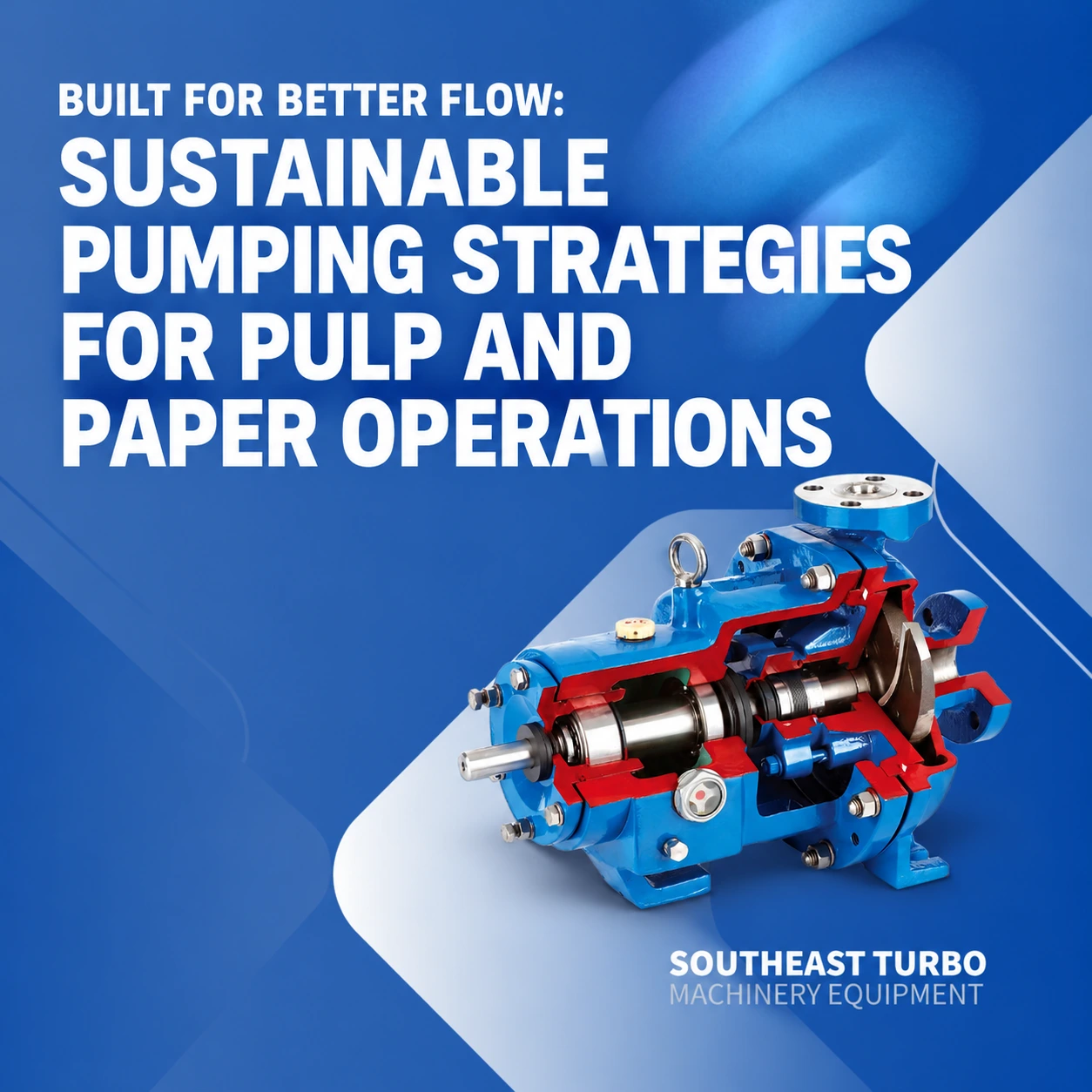
Pulp and paper manufacturing depends on continuous, controlled movement. Pumps move process water, chemicals, slurries, stock, wastewater, and other fluids between critical stages of production. When those pumping systems operate consistently, mills can maintain steadier flow, support product quality, manage resources more effectively, and give maintenance teams greater control over planned work.
When pump performance begins to deteriorate, the effects can spread beyond the equipment itself. Reduced flow, unstable pressure, excessive vibration, rising energy use, or an unexpected shutdown can affect production schedules, maintenance workload, water management, and operating cost. For pulp and paper facilities in Georgia, Florida, and across the Southeast, pump reliability and operating efficiency therefore need to be considered as part of the same system-level strategy.
Reliable pumps are critical in pulp and paper manufacturing because they maintain the controlled movement of water, chemicals, stock, slurries, and wastewater that continuous production depends on. Correct pump selection, efficient system control, condition monitoring, and proper maintenance can reduce unplanned downtime, excessive energy consumption, premature wear, and recurring operating problems.
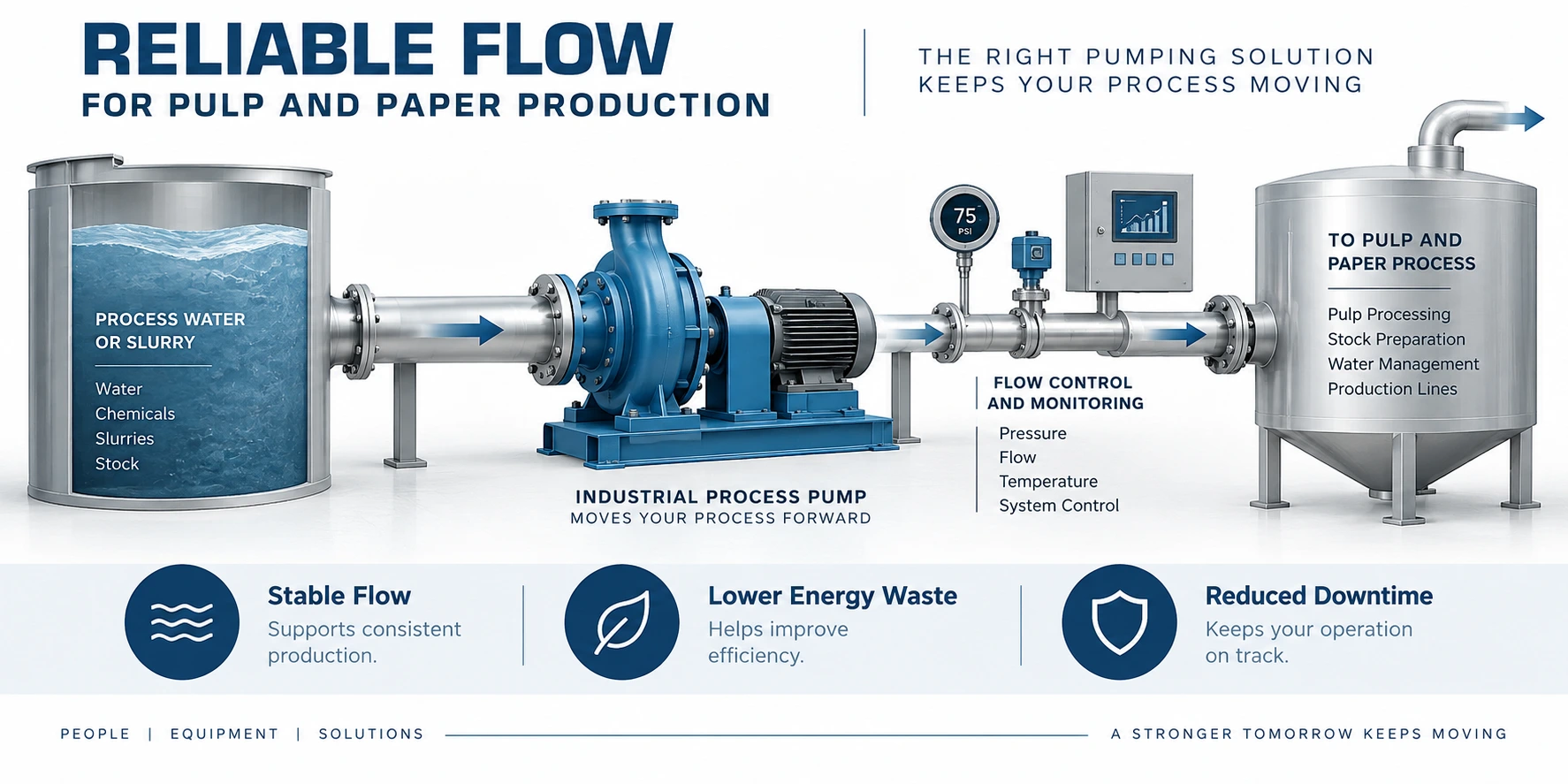
Pulp and paper processes place very different demands on pumping equipment depending on where the pump operates. One system may move relatively clean process water, while another may handle abrasive slurry, chemicals, wastewater, or fluids whose solids content and viscosity change with production conditions.
That variation makes application analysis more important than simply choosing equipment by nominal flow capacity.
Key selection factors include:
A pump that is poorly matched to the application may continue to move fluid while gradually creating other problems. Excessive wear, repeated seal failures, vibration, inefficient power consumption, or declining capacity can become accepted as routine maintenance issues even when the root cause is an application mismatch.
Facilities evaluating equipment for demanding process duties can review STME’s industrial pump solutions as part of a broader system-selection process.
The objective is not simply to install a pump capable of producing the required flow. It is to select equipment that can provide that flow predictably under the actual conditions the process creates.
Pumps in pulp and paper facilities may operate for long production periods, so small efficiency losses can become meaningful over time. A pump that consumes more energy than necessary does not need to be completely failing to create a cost problem.
Efficiency can deteriorate when:
These conditions can increase power consumption while also placing additional mechanical stress on equipment. That makes energy performance useful not only as a cost metric, but also as an indicator of how well the pump and system are working together.
One of the most important efficiency principles is to avoid producing more flow or pressure than the process actually requires.
Where production demand changes, variable frequency drives can allow pump speed to follow actual system requirements more closely. Instead of operating continuously at full speed and restricting flow elsewhere in the system, the pump can adjust output as demand changes.
Other improvements may include better flow control, efficient motors, system monitoring, and reducing avoidable pressure losses. The right approach depends on how the pump interacts with the process rather than on one component in isolation.
Water moves through many stages of pulp and paper production. Pumps support process-water circulation, washdown, recovery systems, wastewater treatment, and water-reuse applications.
That makes pumping performance part of the plant’s broader water-management strategy.
Improving water-system pumping does not simply mean reducing the amount of water used. The larger goal is to move, recover, treat, and reuse water efficiently while maintaining the process conditions production requires.
A properly configured system may help a facility:
The relationship between water management and pump reliability is especially important in continuous-process operations. A water system that becomes unstable can create consequences in processes far beyond the original pump location.
Pump failures are often preceded by changes in operating behavior. Monitoring those changes can help maintenance teams identify problems before they become production interruptions.
Useful condition indicators include:
Changes in these indicators may point toward developing issues such as cavitation, bearing deterioration, misalignment, seal wear, flow restrictions, or operation outside the pump’s intended range.
The value comes from identifying a change early enough to investigate it during a planned maintenance window.
In a continuous pulp and paper operation, the difference between scheduled maintenance and an unexpected shutdown can be significant. Planned work can be coordinated around production requirements. Emergency failures dictate the schedule themselves.
Traditional maintenance programs often rely on fixed service intervals or repairs after equipment has already shown obvious deterioration. Condition-based maintenance adds another layer by evaluating how the pump is actually performing.
Instead of assuming every pump requires the same intervention at the same interval, plant teams can use operating information to identify which equipment deserves closer attention.
For example:
The goal is not to eliminate preventive maintenance. It is to combine routine maintenance practices with operating information so resources can be directed toward equipment showing meaningful signs of deterioration.
A recurring pump problem does not always originate inside the pump.
Piping layout, suction conditions, valves, tanks, controls, pressure losses, and process-demand changes all influence the environment in which the pump operates. If those conditions are unfavorable, replacing the pump may restore service temporarily without correcting the underlying cause.
Examples of problems that deserve a broader system review include:
Looking beyond the machine helps maintenance teams distinguish a component failure from a system condition that continues to damage equipment.
This system-level reliability principle also applies across other industrial applications. STME’s discussion of pump reliability in Georgia agricultural and processing operations shows how equipment performance is closely connected to the conditions surrounding the pump.
The initial cost of a pump is only one part of what the equipment will ultimately cost a facility. Long-term expenses can include electricity, maintenance labor, replacement components, lost production, and the consequences of unplanned downtime.
A lifecycle review should consider:
This provides a more useful framework for deciding whether an existing pump should be repaired, upgraded, or replaced.
An older pump may still be worth repairing when it remains appropriate for the application and dependable performance can be restored economically. Replacement becomes more compelling when failures become frequent, efficiency declines, parts become difficult to source, or production requirements have moved beyond what the existing equipment was selected to handle.
The strongest decision is therefore not necessarily the option with the lowest immediate cost. It is the option that provides the best long-term operating value for the process.
A complete system evaluation does not need to wait for a catastrophic failure. Several operating patterns may justify a closer review before production is interrupted.
Plants should consider evaluating the system when they see:
A review can compare current pump performance with process requirements while also examining piping, valves, suction conditions, controls, and other system factors.
That helps determine whether the next step should be maintenance, a system adjustment, control changes, equipment modification, or replacement.
Pumping systems touch multiple priorities in pulp and paper manufacturing. They influence production continuity, energy consumption, water movement, equipment maintenance, and the ability of surrounding processes to operate consistently.
Correct pump selection provides the starting point. Efficient controls help match equipment output to demand. Monitoring provides visibility into developing problems. Maintenance protects equipment condition. System-level analysis helps prevent the same failures from repeating.
When those elements work together, the result is not simply a more reliable pump. It is a more predictable process.
Pulp and paper facilities in Georgia, Florida, and throughout the Southeast depend on pumping systems that can handle demanding process conditions while supporting stable production. Reliable performance requires more than selecting equipment by flow and pressure alone.
Fluid properties, solids content, suction conditions, system resistance, controls, energy use, maintenance history, and changing production demand all influence how well a pump performs over its lifecycle.
For facilities dealing with recurring pump problems, rising utility costs, excessive maintenance, or changing process requirements, evaluating the complete pumping system can reveal whether the existing equipment is still supporting the operation effectively.
To discuss a pulp and paper pumping application or review equipment requirements, contact Southeast Turbo Machinery Equipment.
Pumps in pulp and paper facilities may move process water, chemicals, slurries, stock, wastewater, and other fluids with different solids content, viscosity, temperature, and abrasiveness.
Pump selection should consider flow, pressure, fluid composition, viscosity, solids content, abrasiveness, temperature, materials of construction, suction conditions, duty cycle, and maintenance accessibility.
Plants can improve pump efficiency through proper sizing, variable frequency drives, improved flow control, efficient motors, system monitoring, and reducing unnecessary pressure losses.
Changes in vibration, temperature, flow, pressure, power consumption, or maintenance frequency can indicate problems such as cavitation, bearing deterioration, misalignment, seal wear, flow restrictions, or operation outside the intended range.
Recurring failures may be caused by piping, suction conditions, valves, controls, pressure losses, or changing process demand rather than the pump alone. Evaluating the complete system helps identify root causes instead of repeatedly correcting symptoms.

