
For growers, an irrigation failure during hot weather can place crop performance at risk. For processors, unstable flow can reduce throughput, increase maintenance demands, interfere with sanitation, and tighten production schedules. Across both environments, pump reliability is ultimately about maintaining predictable flow, protecting uptime, controlling operating cost, and keeping Georgia’s peanut supply chain moving.
Why Does Pump Reliability Matter in Georgia’s Peanut Industry?
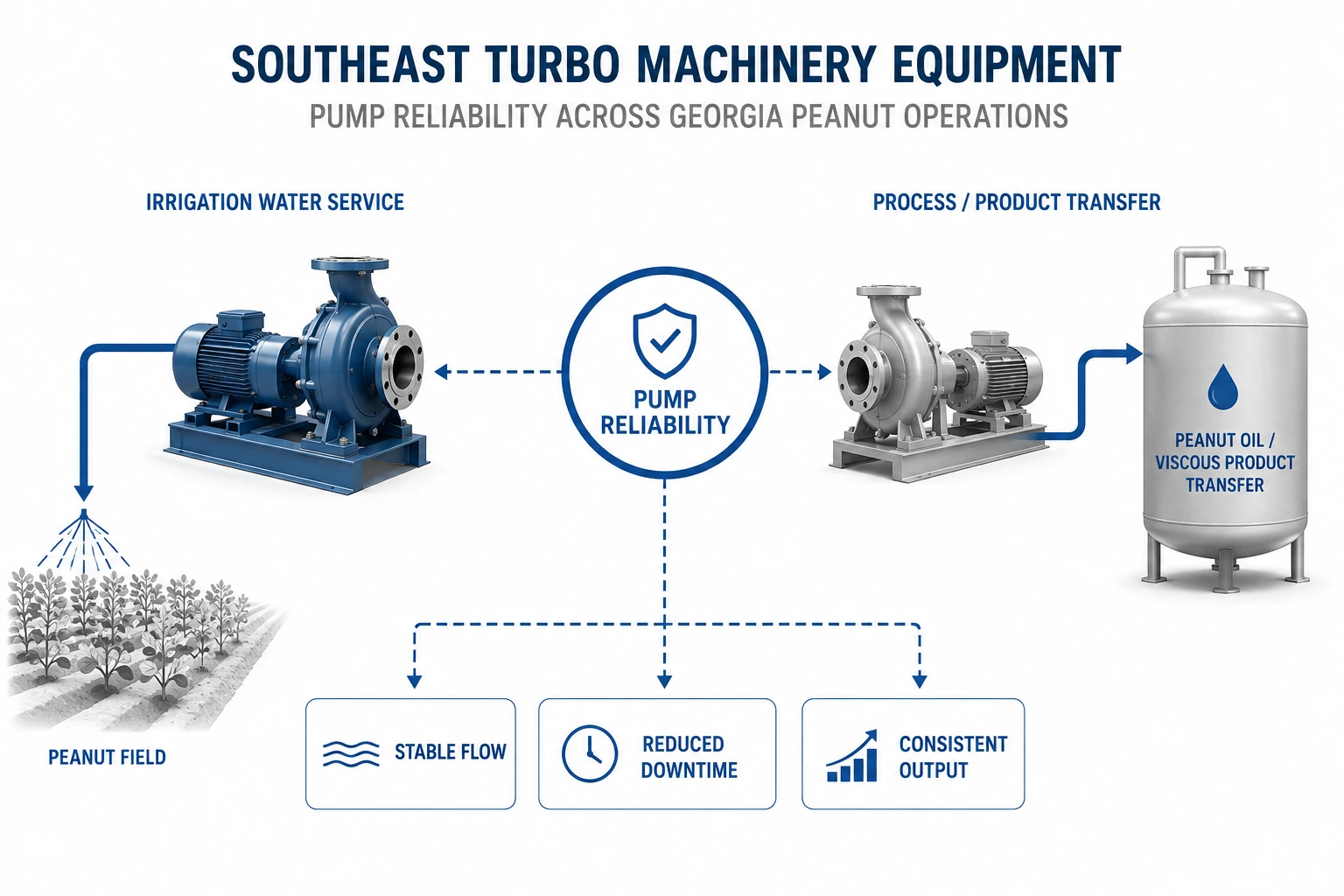
Pump reliability matters because peanut farming and processing both depend on consistent fluid movement. Reliable irrigation pumps help protect crops from moisture stress, while properly selected process pumps help move water, peanut oil, viscous products, and wastewater at the flow, pressure, temperature, and sanitation conditions required by the operation. Better reliability reduces unplanned downtime, supports steady production, and helps control lifecycle cost.
Key Takeaways
- Reliable irrigation pumps help protect peanut crops during critical growth periods and periods of high heat.
- Processing facilities require pumps matched to viscosity, pressure, temperature, sanitation needs, and duty cycle rather than capacity alone.
- Poor pump efficiency can increase energy use, maintenance expense, and the risk of unexpected shutdowns.
- Maintenance history and total system performance should be considered together when deciding whether to repair or replace aging equipment.
- Reliable pumping equipment supports consistent output across farming, processing, and downstream agricultural markets.
Reliable Irrigation Starts with the Right Pump System
Peanut crops can be vulnerable to moisture stress during important growth stages, including pegging and pod development. In many peanut-growing areas of Georgia, sandy soil drains quickly. As a result, irrigation performance can have a direct effect on how consistently growers are able to maintain adequate soil moisture.
Centrifugal pumps and vertical turbine pumps are commonly used where agricultural operations need to move substantial volumes of irrigation water. However, flow capacity is only part of the decision. The pump, motor, piping, suction conditions, and system operating point all affect how reliably and efficiently water reaches the field.
During peak summer conditions, a pump failure can quickly become a production problem rather than a routine maintenance issue. Crops cannot always wait for lengthy troubleshooting or replacement-part delays. Therefore, equipment condition and preventive maintenance become especially important before and during the highest-demand periods of the growing season.
Efficiency Matters During Long Irrigation Cycles
Irrigation systems may operate for long periods during dry weather. Because of those extended run times, inefficient pumping can create substantial hidden cost over a season. A pump operating far from its intended efficiency range may still deliver water, but it may require more power and place unnecessary stress on mechanical components.
Reviewing pump performance, motor condition, system resistance, and actual operating requirements can help determine whether the system is delivering the required water efficiently rather than simply continuing to run.
Peanut Processing Requires Application-Specific Pump Selection
Once peanuts enter a processing facility, the pumping requirements change significantly. Instead of primarily moving irrigation water, plants may need to transfer process water, peanut oil, viscous food products, cleaning fluids, or wastewater under very different operating conditions.
Common pumping applications may include:
- Washing and cleaning operations
- Peanut oil transfer
- Peanut butter and other viscous product movement
- Process-water circulation and transfer
- Wastewater handling
Processors evaluating equipment for these applications can review STME’s industrial pump solutions as part of the equipment-selection process.
Products such as peanut butter place very different demands on a pump than water does. Viscosity, product sensitivity, required flow, pressure, temperature, cleaning expectations, and duty cycle all influence equipment selection. Positive displacement pump designs can be useful where consistent movement of higher-viscosity products is required, while centrifugal designs may be more appropriate for other lower-viscosity process duties.
For a closer look at pump considerations in thick food products, STME’s resource on pump technology for viscous food processing discusses the relationship between product handling, cleanability, and operating consistency.
Why Pump Capacity Alone Is Not Enough
Selecting a pump based only on flow capacity can create reliability problems later. A unit may appear capable of meeting the required gallons per minute while still being poorly matched to the actual fluid or system.
A stronger application review considers factors such as:
- Fluid viscosity and product characteristics
- Required flow and discharge pressure
- Operating temperature
- Duty cycle and expected run time
- Sanitation and cleanability requirements
- Suction conditions
- System piping and resistance
- Maintenance access and service expectations
These conditions affect whether a pump can operate predictably over time. When the equipment does not match the application, operators may compensate for unstable flow, maintenance teams may face recurring repairs, and the system can gradually become a production bottleneck.
In food applications where sealing and residue buildup are important concerns, pump seal reliability in viscous product processing is another factor worth evaluating.
How Pump Efficiency Affects Total Operating Cost
A pump’s purchase price is only one part of its lifetime cost. Energy consumption, labor, maintenance, replacement parts, process losses, and downtime can eventually represent a much larger financial commitment.
An aging pump can continue operating while becoming increasingly expensive to keep in service. Warning signs may include:
- Operation far from the pump’s efficient operating range
- Increasing power consumption
- Recurring bearing or seal failures
- Loss of hydraulic performance
- Frequent maintenance intervention
- Increasing risk of an unplanned shutdown
Because deterioration often happens gradually, inefficient operation can become accepted as normal. Reviewing the complete system can reveal whether repeated repairs are correcting the underlying problem or simply extending the life of equipment that no longer matches the application.
Total Cost of Ownership Gives a Better Decision Framework
A total-cost-of-ownership review can include pump performance, motor condition, operating hours, maintenance history, energy use, downtime exposure, replacement-part availability, and the current production requirement. Looking at these factors together gives operations teams a clearer basis for deciding whether continued repair remains economical.
Pump Reliability Supports the Broader Peanut Supply Chain
Peanut production does not end when peanuts leave the field. Processing creates products and co-products that serve several downstream markets. Peanut oil can enter food and ingredient applications, while peanut meal remaining after oil extraction can be used as a protein ingredient in livestock feed.
Because these operations are connected, reliability problems can move downstream. Reduced irrigation performance can affect crop availability. Repeated failures inside a processing plant can constrain oil, food-product, or meal production. Those disruptions can then create scheduling and inventory pressure elsewhere in the supply chain.
A pump may represent only one component in a much larger agricultural operation, but dependable pump performance helps preserve predictable flow and production capacity throughout that system.
When Should an Aging Pump Be Repaired or Replaced?
Repair versus replacement is rarely a simple age-based decision. The more useful question is whether the existing pump can still meet the application efficiently, reliably, and economically.
Replacement may deserve closer consideration when:
- Repair expense is approaching roughly 60% to 70% of the cost of replacement equipment
- Efficiency has declined noticeably
- Failures or shutdowns are becoming more frequent
- Replacement parts are becoming difficult to obtain
- The pump no longer matches current production requirements
- Recurring failures are creating unacceptable downtime exposure
The repair-cost percentage should be treated as a screening guideline rather than a universal rule. A better decision considers downtime risk, equipment condition, service history, efficiency, parts availability, and the cost of operating the current system.
Reviewing those factors before the next emergency failure allows maintenance and operations teams to make a planned equipment decision instead of a rushed one.
Building Pump Reliability into the Operation
Reliable pump performance is usually the result of several decisions working together. Proper equipment selection establishes the foundation, but maintenance, operating conditions, system design, and performance monitoring determine whether that equipment continues to meet expectations.
A practical reliability review may include:
- Confirming that the pump still matches current flow and pressure requirements
- Reviewing changes in fluid properties or production demand
- Checking maintenance history for repeat failure patterns
- Evaluating energy use and motor performance
- Inspecting seals, bearings, alignment, and other wear points
- Determining whether piping or system conditions are contributing to poor performance
The objective is not simply to replace a failed component. It is to understand why performance is deteriorating and determine what change will best support the long-term application.
The Bottom Line
From irrigation systems serving peanut farms across South Georgia to processing facilities producing peanut butter, oil, ingredients, and livestock feed, reliable pumps help keep Georgia’s peanut industry operating. In the field, dependable irrigation protects crop production during periods when water demand is high. Inside processing plants, properly selected pumps support stable product movement, sanitation, throughput, and predictable schedules.
Long-term reliability requires more than waiting for equipment to fail. Pump selection, operating efficiency, maintenance history, system conditions, and lifecycle cost all deserve attention. When recurring failures, increasing energy use, reduced capacity, or repeated maintenance begin to appear, evaluating the complete pumping system can provide a clearer path forward.
If your agricultural or processing operation is experiencing pump reliability problems, Southeast Turbo Machinery Equipment can help evaluate the application and equipment requirements. Contact STME to discuss your pumping application.
Frequently Asked Questions
Why are pumps important in Georgia peanut farming and processing?
Pumps support irrigation, washing, process-water movement, peanut oil transfer, viscous product handling, and wastewater systems. Reliable pump performance helps farms and processing facilities maintain consistent operation and reduce downtime.
What types of pumps are used in peanut operations?
Centrifugal and vertical turbine pumps are commonly used for irrigation, while processing applications may use centrifugal or positive displacement pumps depending on the fluid, viscosity, pressure, sanitation requirements, and operating conditions.
What factors should be considered when selecting a pump for peanut butter or peanut oil?
Pump selection should consider viscosity, flow rate, pressure, temperature, product characteristics, sanitation requirements, duty cycle, cleaning needs, and the overall system configuration.
How can inefficient pumps increase operating costs?
Inefficient pumps can use more energy, require more frequent maintenance, lose hydraulic performance, and increase the risk of downtime. These costs can make an aging system more expensive to operate even if the pump is still running.
When should a pump be replaced instead of repaired?
Replacement should be considered when repair costs are becoming high relative to new equipment, efficiency has declined, failures are increasing, parts are difficult to obtain, or the existing pump no longer meets the application’s operating requirements.
