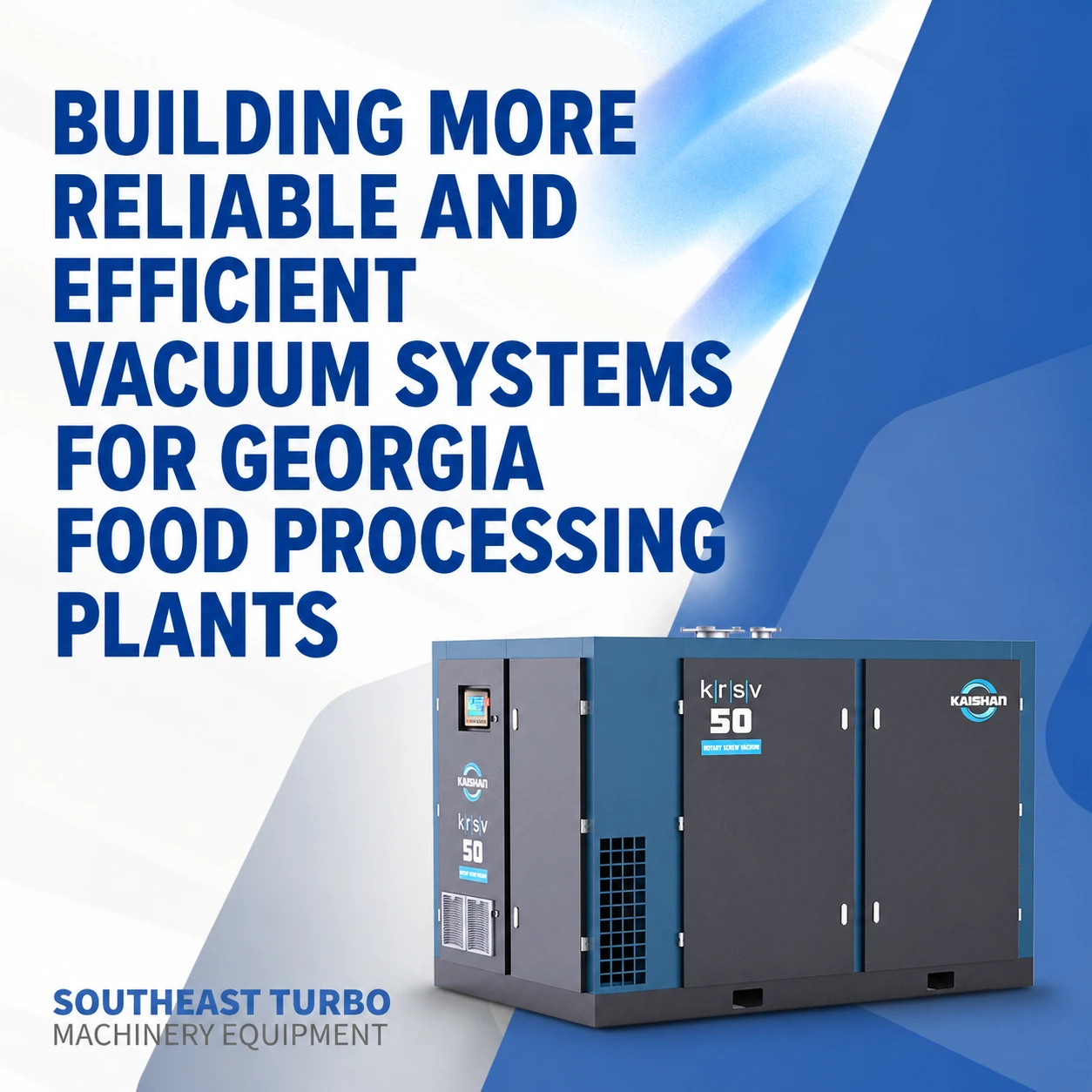
Georgia food processing plants operate under constant pressure to maintain throughput, control operating costs, meet sanitation requirements, and prevent disruptions across high-volume production environments. Behind many of those processes, vacuum systems support material handling, packaging, conveying, waste removal, and other production functions that depend on stable suction and predictable equipment performance.
When vacuum performance becomes unstable, the impact can extend well beyond the equipment itself. Production may slow, maintenance teams may be pulled into emergency repairs, energy consumption can rise, and downstream processes may lose the consistency they depend on. For that reason, vacuum reliability and efficiency should be evaluated together rather than treated as separate priorities.
Reliable vacuum systems help food processing plants maintain consistent material movement, packaging performance, conveying, waste handling, and other vacuum-dependent processes. A properly selected and maintained system can reduce unplanned downtime, maintain required vacuum levels more efficiently, lower unnecessary energy use, and give maintenance teams a more predictable operating environment.
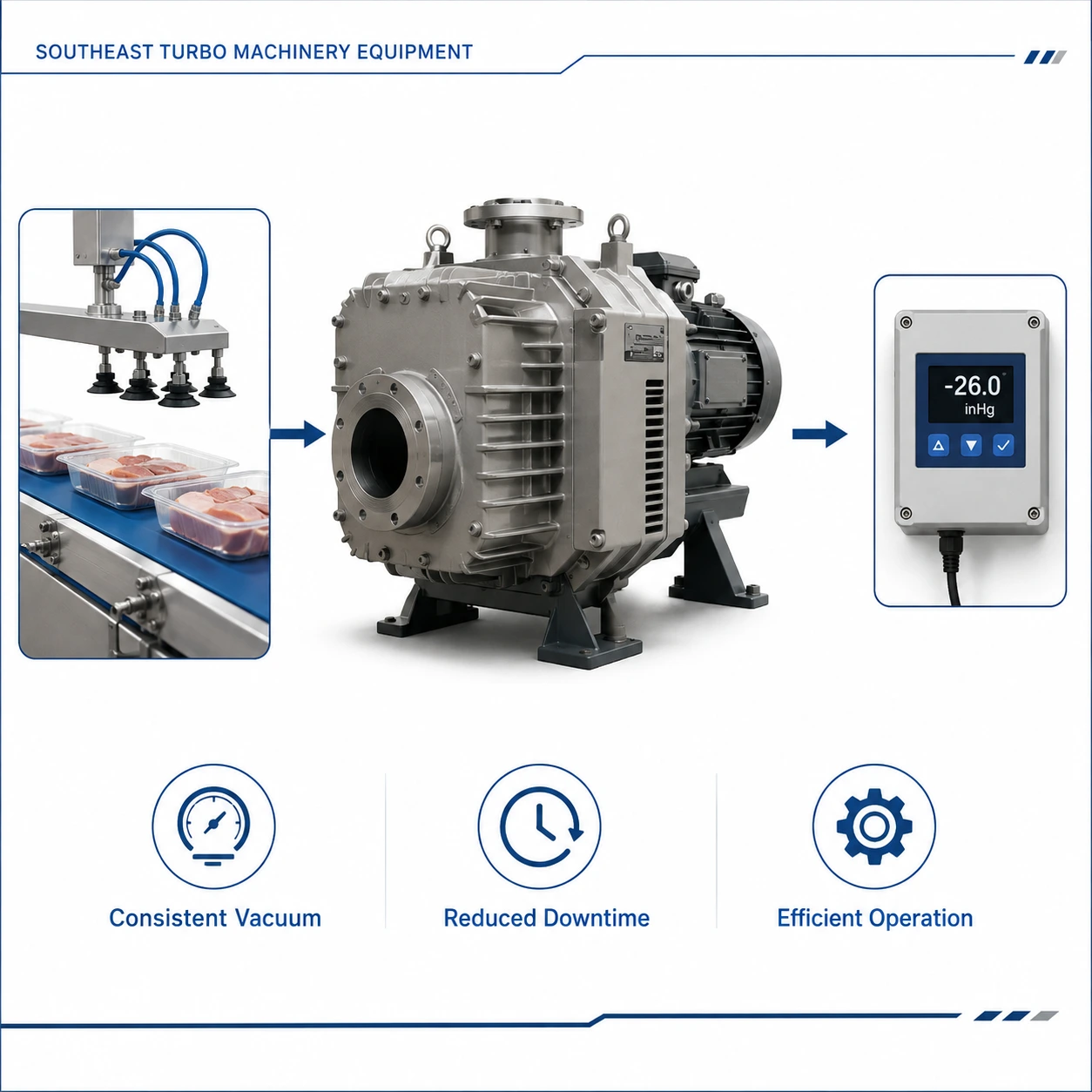
Food processing plants can be difficult operating environments for rotating equipment. Vacuum systems may run continuously, cycle repeatedly, encounter moisture, experience temperature changes, and respond to production schedules that vary throughout the day.
Those conditions make application analysis essential. Selecting a vacuum pump based only on the required vacuum level can overlook other factors that determine whether the system will remain reliable after installation.
A practical vacuum system review should consider:
When these conditions are understood before equipment is selected, the system can be matched more closely to the process. That can reduce unnecessary stress on the equipment and provide maintenance teams with more predictable performance.
Southeast Turbo Machinery Equipment approaches vacuum and rotating-equipment applications by considering the operating requirements surrounding the equipment rather than treating every facility as if it has the same demand profile.
Vacuum equipment may operate for thousands of hours during its service life, which means small inefficiencies can accumulate into significant operating expense. A system can continue producing vacuum while consuming more energy than the process actually requires.
Common contributors to inefficient operation include:
An oversized pump, for example, may provide enough capacity while using more energy than necessary. Likewise, leaks can force the vacuum equipment to work harder simply to maintain the required operating level.
The better question is not whether the pump still runs. It is whether the complete vacuum system is producing the required performance efficiently under real production conditions.
Industrial sustainability often begins with practical improvements in equipment performance. When a vacuum system delivers the required process conditions with less wasted energy and fewer unnecessary operating hours, the facility can reduce utility expense without compromising production.
Depending on the application, a better-matched vacuum system can help:
However, efficiency improvements should not be limited to replacing one piece of equipment. Actual demand, load variation, piping losses, equipment condition, operating schedules, and control strategy should be reviewed together.
For facilities evaluating other air-dependent production systems, STME also provides industrial compressors and compressed air systems for demanding plant applications.
Vacuum systems used in food processing environments affect more than suction. Their performance can influence material movement, packaging consistency, waste handling, housekeeping, and the reliability of surrounding equipment.
If a vacuum system cannot maintain stable performance, operators may see changes in process behavior while maintenance teams spend more time responding to recurring equipment problems. Leaks and declining vacuum performance can also cause the equipment to operate harder, adding energy consumption and mechanical stress.
A properly selected and maintained system provides a more stable operating foundation. Depending on the equipment and application, modern vacuum technology may also incorporate more effective controls, efficient motors, improved sealing, or operating configurations designed to reduce unnecessary resource use.
The broader lesson is that sanitation, reliability, energy efficiency, and production performance are closely connected. Equipment that is easier to operate predictably also gives plant teams more control over the processes surrounding it.
For another look at the relationship between equipment design, sanitation, and operating efficiency in food plants, see STME’s resource on sustainable sanitation and processing equipment.
A vacuum leak changes the relationship between the process and the equipment supplying it. As unwanted air enters the system, the vacuum pump may need to work harder to maintain the target condition.
That can create several operational consequences:
Because leaks may develop gradually, their cost can be easy to overlook. A plant may compensate for declining performance without recognizing that the equipment is now using more capacity simply to overcome losses elsewhere in the system.
Checking piping, fittings, valves, seals, and process connections should therefore be part of a broader vacuum-performance review before assuming the pump itself is the only problem.
Production demand is rarely identical every minute of every shift. Yet a poorly controlled vacuum system may continue operating at a fixed condition even when the process does not require full capacity.
Controls help align equipment operation more closely with actual demand. The exact approach depends on the application and system configuration, but better control can improve responsiveness and reduce unnecessary operation.
For maintenance and operations teams, improved visibility can also make performance easier to evaluate. Instead of waiting for a major failure, teams can identify changes in vacuum level, operating temperature, run time, or other performance indicators that may signal developing problems.
This moves the maintenance strategy away from purely reactive repair and toward more informed system management.
The acquisition cost of a vacuum pump matters, but it represents only part of the total cost of owning the system. Energy use, maintenance labor, routine service, replacement components, production losses, and downtime can eventually exceed the initial purchase price.
An aging vacuum system may continue operating while showing signs that its lifecycle cost is increasing. Those warning signs may include:
Repeated repairs may seem less expensive than replacing equipment, especially when viewed one work order at a time. However, that approach can hide the cumulative cost of labor, parts, energy waste, and recurring production interruptions.
A lifecycle evaluation provides a better framework by comparing current operating cost and maintenance history with the expected performance of an improved or better-matched system.
A vacuum system does not need to fail completely before it deserves closer evaluation. Changes in performance often develop gradually, giving maintenance and operations teams an opportunity to investigate before an emergency shutdown occurs.
A broader system review may be worthwhile when:
The first step does not always need to be replacement. In many cases, understanding actual process demand, system losses, control behavior, equipment condition, and maintenance history can reveal where the problem originates.
Replacing a failed component can restore operation, but it does not necessarily solve the condition that caused the failure. If piping losses, leaks, poor controls, equipment sizing, operating temperature, or process conditions are contributing to the problem, the same failure pattern may return.
That is why vacuum reliability is best viewed from a system perspective. Maintenance history should be considered alongside actual operating conditions and production requirements.
STME’s application-focused approach evaluates equipment as part of the broader process. For facilities with other critical rotating-equipment needs, the company also supports industrial pump applications across demanding production environments.
Reliable vacuum systems help Georgia food processing plants protect production, control energy use, maintain process consistency, and reduce the maintenance burden created by unstable or poorly matched equipment. The best-performing system is not simply the one capable of producing the required vacuum level. It is the one that can meet real production demand efficiently and predictably over time.
When utility costs rise, vacuum levels become unstable, repairs become more frequent, or production demands change, evaluating the complete system can provide more useful answers than focusing on the latest equipment failure alone.
If your facility is experiencing recurring vacuum problems, increasing energy consumption, or equipment that no longer matches production demand, contact Southeast Turbo Machinery Equipment to discuss the application and operating requirements.
Vacuum systems can support material handling, packaging, conveying, waste removal, and other production processes that require controlled suction or vacuum conditions.
Common causes include vacuum leaks, oversized equipment, poor controls, excessive piping losses, declining equipment condition, and operating the system outside the range that best matches actual process demand.
Unstable vacuum can interrupt material movement, packaging, conveying, or waste handling while increasing maintenance demands and creating production delays.
An upgrade may deserve consideration when energy use is increasing, vacuum performance is unstable, repairs are becoming frequent, downtime risk is rising, or existing equipment no longer matches current production requirements.
No. Selection should also consider actual process demand, duty cycle, piping, controls, moisture, temperature, maintenance requirements, load variation, and expected changes in production.

